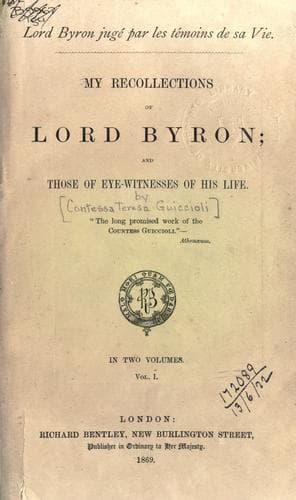
My Recollections of Lord ByronGuiccioli, Teresa, contessa di
General
My Recollections of Lord Byron
Guiccioli, Teresa, contessa di
Byron, George Gordon Byron, Baron, 1788-1824; Poets, English -- 19th century -- Biography
"I passed my degrees in vice," he says, "very quickly, _but they were
not after my taste_. For my juvenile passions, though most violent, were
concentrated, and did not willingly tend to divide and expand on several
objects. I could have renounced every thing in the world with those I
loved, or lost it all for them; but fiery though my nature was, _I
could not share without disgust in the dissipation common to the place,
and time._"
This makes Moore say, that even at the period to which we are alluding,
his irregularities were much less sensual, much less gross and varied
than those of his companions.
Nevertheless it was his boyish university life that caused Lord Byron to
be suspected of drawing his own likeness, when two years later, after
his return from the East, he brought out "Childe Harold"--an imaginary
hero, whom he imprudently surrounded with real circumstances personal to
himself.
Moore, with his usual good sense, protests strongly against such
injustice, saying that, however dissipated his college and university
life might have been during the two or three years previous to his first
travels, no foundation exists, except in the imagination of the poet,
and the credulity or malice of the world, for such disgraceful scenes as
were represented to have taken place at Newstead, by way of inferences
drawn from "Childe Harold." "In this poem," adds Moore, "he describes
the habitation of his hero as a monastic dwelling----
'Condemn'd to uses vile!
Where Superstition once had made her den
Now Paphian girls were known to sing and smile.'"
These exaggerated, if not imaginary descriptions, were, nevertheless,
taken for serious, and literally believed by the greater part of his
readers.
Moore continues: "Mr. Dallas, giving way to the same exaggerated tone,
says, in speaking of the preparations for departure made by the young
lord, 'He was already satiated with pleasure, and disgusted with those
comrades who possessed no other resource, so he resolved to overcome his
senses, and accordingly dismissed his harem.' The truth is, that Lord
Byron did not then even possess sufficient fortune to allow himself this
Oriental luxury; his manner of living at Newstead was plain and simple.
His companions, without being insensible to the pleasures afforded by
liberal hospitality, were all too intellectual in their tastes and
habits to give themselves up to vulgar debauchery. As to the allusions
regarding his _harem_, it appears certain that one or two women were
suspected _subintroductae_--to use the style of the old monks of the
Abbey--but that even these belonged to the servants of the house. This
is the utmost that scandal could allege as the groundwork for suspicion
and accusation."
Public-domain text, read in full here on John Shaqi.
Reviews
Reviews
No reviews yet
Be the first to share your thoughts on this work.
Elsewhere in the archive
Join the Discussion
Join the discussion
Sign in to leave a comment or review.
Sign InorCreate an account