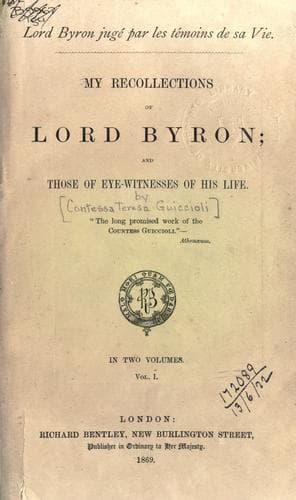
My Recollections of Lord ByronGuiccioli, Teresa, contessa di
General
My Recollections of Lord Byron
Guiccioli, Teresa, contessa di
Byron, George Gordon Byron, Baron, 1788-1824; Poets, English -- 19th century -- Biography
Instead of going in quest of emotions, his desire was, on the contrary,
to avoid both those of the heart and of the senses. The admiration felt
by the young traveller for charming Spanish women and beautiful Greeks
did not outstep the limits of the purest poetry. Nevertheless the
stoicism of twenty, with a heart, sensibility and imagination like his,
could not be very firm, nor always secure from danger. He did actually
meet with a formidable enemy at Malta; for he there made acquaintance
with Mrs. Spencer Smith, the daughter of one ambassador and the wife of
another, a woman most fascinating from her youth, beauty, mind, and
character, as well as by her singular position and strange adventures.
Did he avoid her so much as the stanzas addressed to the lovely
Florence, in the first canto of "Childe Harold," would fain imply? This
may be doubted, on account of the ring which they exchanged, and also
from several charming pieces of verse that testify to another sentiment.
In any case, he showed strength of mind, and that his senses were under
the dominion of reason; for, unable to secure her happiness or his own,
he sought a remedy in flight.
When writing "Childe Harold," however, about this period, an evil genius
suggested expressions, that if taken seriously and in their literal
sense, might some day furnish the weapons of accusation to his enemies.
For, while acting thus toward Florence, he introduced the episode into
"Childe Harold" in a way that looks calumnious against himself:----
"Little knew she that seeming marble heart,
Now mask'd in silence or withheld by pride,
Was not unskillful in the spoiler's art,
And spreads its snares licentious far and wide;
Nor from the base pursuit had turn'd aside,
As long as aught was worthy to pursue."
"We have here," says Moore, "another instance of his propensity to
self-misrepresentation. However great might have been the irregularities
of his college life, such phrases as the 'art of the spoiler' and
'spreading snares' were in no-wise applicable to them."[44]
Galt expresses the same certainty on this head. "Notwithstanding," says
he, "the unnecessary exposure he makes of his dissipation on his first
entrance into society (in the first two cantos of 'Childe Harold'), it
is proved beyond _all dispute_, that at no period of his existence did
Lord Byron _lead an irregular life_. That on one or two occasions he
fell into some excesses, may be true; _but his habits were never those
of a libertine_."[45]
And after saying that the declaration by which Byron himself
acknowledges his antipathy to vice carries more weight than all the
rest, and that what he says of it is vague and metaphysical, he
adds:--"But that only further corroborates my impression concerning
him,--that is to say, that he took a sort of vanity in setting forth his
experience in dissipation, but _that this dissipation never became a
habit with him_."
Public-domain text, read in full here on John Shaqi.
Reviews
Reviews
No reviews yet
Be the first to share your thoughts on this work.
Elsewhere in the archive
Join the Discussion
Join the discussion
Sign in to leave a comment or review.
Sign InorCreate an account