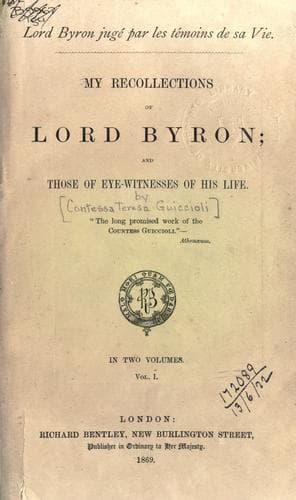
My Recollections of Lord ByronGuiccioli, Teresa, contessa di
General
My Recollections of Lord Byron
Guiccioli, Teresa, contessa di
Byron, George Gordon Byron, Baron, 1788-1824; Poets, English -- 19th century -- Biography
His true sentiments at this time are well portrayed in his letters, and
especially in those addressed to his mother from Athens, when she
consulted him on the conduct to be observed toward one of his tenants, a
young farmer, who had behaved ill to a girl. "My opinion is," answered
he, "that Mr. B---- ought to marry Miss K----. _Our first duty is not to
do evil_ (but, alas! that is not possible); our second duty _is to
remedy it, if that be in our power_. The girl is his equal. If she were
inferior to him, a sum of money and an allowance for the child might be
something,--although, after all, a miserable compensation; but, under
the circumstances, he ought to marry her. I will not have _gay seducers_
on my estate, nor grant my farmers a privilege _I would not take myself
of seducing other people's daughters_. I expect, then, this Lothario to
follow my example, and begin by restoring the girl to society, or, by my
father's beard, he shall hear of me."
To this letter Moore justly adds:--"The reader must not pass lightly
over this letter, for there is a _vigor of moral sentiment_ in it,
expressed in such a plain, sincere manner, that it shows how full of
health his heart was at bottom, even though it might have been scorched
by passion."
Lord Byron returned to his own country, after having spent two years
travelling in Spain, Portugal, and the East, in the study and
contemplation requisite for maturing his genius.
His distaste for all material objects of love or passion, and, in
general, for sensual pleasures, was then remarked by all those who knew
him intimately.
"An anchorite," says Moore, "who knew Lord Byron about this time, could
not have desired for himself greater _indifference toward all the
attractions of the senses_, than Lord Byron showed at the age of
twenty-three."
And as on arriving in London he met with a complication of sorrows, he
could, without any great effort, remain on his guard against all
seductions. He did so in reality; and Dallas assures us that, even when
"Childe Harold" appeared, he still professed positive distaste for the
society of women. Whether this disposition arose from regret at the
death of one he had loved, or was caused by the light conduct of other
women, it is certain that he did not seek their society then; nay, even
avoided them.
"I have a favor to ask you," he wrote, during this sad time, to one of
his young friends: "never speak to me in your letters of a woman; make
no allusion to the sex. I do not even wish to read a word about the
feminine gender."
And to this same friend he wrote in verse:----
"If thou would'st hold
Place in a heart that ne'er was cold,
By all the powers that men revere,
By all unto thy bosom dear,
Thy joys below, thy hopes above,
Speak--speak of any thing but love."
_Newstead Abbey, October 11, 1811._
Public-domain text, read in full here on John Shaqi.
Reviews
Reviews
No reviews yet
Be the first to share your thoughts on this work.
Elsewhere in the archive
Join the Discussion
Join the discussion
Sign in to leave a comment or review.
Sign InorCreate an account