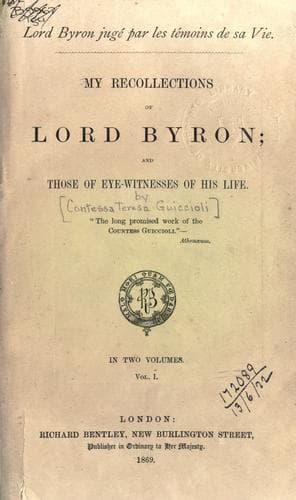
My Recollections of Lord ByronGuiccioli, Teresa, contessa di
General
My Recollections of Lord Byron
Guiccioli, Teresa, contessa di
Byron, George Gordon Byron, Baron, 1788-1824; Poets, English -- 19th century -- Biography
Let us now reverse the picture, and pass from shade to light: the
difference is striking.
Passing in review his former life, Lord Byron said one day to Mr.
Medwin:--"You may not compare me to Scipio, but I can assure you that _I
never seduced any woman_."
No, certainly he did not pretend to rival Scipio; his fault was, on the
contrary, that he took pleasure in appearing the reverse. And yet Lord
Byron often performed actions during his short life that Scipio himself
might have envied. And who knows whether in any case Scipio could have
had the same merit?--for, in order to attain that, he would have
required to overcome such sensibility, imagination, and heart, as were
possessed by Lord Byron.
The single fact of being able to say, "I never seduced any woman," is a
very great thing, and we may well doubt whether many of his detractors
could say as much. But let us relate facts.
In London the mother of a beautiful girl, hard pressed for money, had
recourse to Lord Byron for a large sum, making him an unnatural offer at
the same time. The mother's depravity filled him with horror. Many men
in his place would have been satisfied with expressing this sentiment
either in words or by silence. But that was not enough for his noble
heart, and he subtracted from his pleasures or his necessities a sum
sufficient to save the honor of the unfortunate girl. At another time,
shortly before his marriage, a charming young person, full of talent,
requiring help, through some adverse family circumstances, and attracted
to Lord Byron by some presentiment of his generosity, became
passionately _in love_ with him. She could not live without his image
before her. The history of her passion is quite a romance. Utterly
absorbed by it, she was forever seeking pretexts for seeing him. A word,
a sign, was all she required to become any thing he wished. But Lord
Byron, aware he could not make her happy and respectable, never allowed
that word to pass his lips, and his language breathed only counsels of
wisdom and virtue.[46]
Even at Venice, when his heart had no preference, we find him saving a
young girl of noble birth from the danger caused by his involuntary
fascinations.[47] In Romagna, at Pisa, in Greece, he also gave similar
proofs of virtue and of his delicate sense of honor.
Let us now examine his words. In 1813, with regard to "The
Monk," by Lewis, which he had just read, Lord Byron wrote in his
memoranda:--"These descriptions might be written by Tiberius, at
Caprera. They are overdrawn; the essence of vicious voluptuousness. As
to me, I can not conceive how they could come from the pen of a man of
twenty, for Lewis was only that age when he wrote 'The Monk.' These
pages are not natural; they distill cantharides.
"I had never read this work, and have just been looking over it out of
sheer curiosity, from a remembrance of the noise the book made, and the
name it gave Lewis. But really such things can not even be dangerous."
Public-domain text, read in full here on John Shaqi.
Reviews
Reviews
No reviews yet
Be the first to share your thoughts on this work.
Elsewhere in the archive
Join the Discussion
Join the discussion
Sign in to leave a comment or review.
Sign InorCreate an account