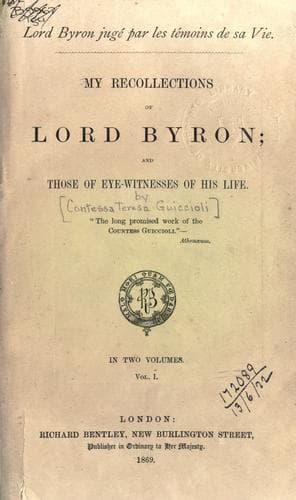
My Recollections of Lord ByronGuiccioli, Teresa, contessa di
General
My Recollections of Lord Byron
Guiccioli, Teresa, contessa di
Byron, George Gordon Byron, Baron, 1788-1824; Poets, English -- 19th century -- Biography
About the same period Mr. Allen, a friend of Lord Holland, very
learned--a perfect Magliabecchi--a devourer of books, and an observer of
mankind, lent Lord Byron a quantity of unpublished letters by the poet
Burns--letters that were very unfit to see the light of day, being full
of oaths and obscene songs. After reading them, Lord Byron wrote in his
memoranda:----
"What an antithetical intelligence! Tenderness and harshness, refinement
and vulgarity, sentiment and sensuality; now soaring up into ether, and
then dragging along in mud. Mire and sublimity; all that is strangely
blended in this admixture of inspired dust. It may seem strange, but to
me it appears that a true voluptuary should never abandon his thought to
the coarseness of reality. It is only by exalting whatever terrestrial,
material, physical element there is in our pleasures, by veiling these
ideas, or forgetting them quite, or, at least, by never boldly naming
them to ourselves, only thus can we avoid disgust."
This is how Lord Byron understood voluptuousness. We might multiply such
quotations without end, taking them from every period of his life; all
would prove the same thing.
As to his poetry written at this time, especially the lyrical pieces
where he expresses his own sentiments, what can there be more chaste,
more ethereal? When a boy, he begins by consigning to the flames a whole
edition of his first poems, on account of a single one, which the Rev.
Dr. Beecher considered as expressing sentiments too warm for a young
man. In his famous satire, written at twenty, he blames Moore's poetry
for its effeminate and Epicurean tendencies, and he stigmatized as evil
the whole poem of "The Ausonian Nun," and all the sensualities contained
in it. In his "Childe Harold," his Eastern tales, his lyric poems above
all, where he displays the sentiments of his own heart, every thing is
chaste and ethereal. The way in which the public appreciated these poems
may be summed up in the words used by the Rev. Mr. Dallas--the living
type of Puritanism in its most exaggerated form--at a date when, through
many causes, Lord Byron no longer even enjoyed his good graces.
"After 1816," says he (the time at which Lord Byron left England), "I
had no more personal intercourse with him, but I continued to read his
new poems with the greatest pleasure until he brought out 'Don Juan.'
That I perused with a real sorrow that no admiration could overcome.
Until then his truly English muse had despised the licentious tone
belonging to poets of low degree. But, in writing 'Don Juan,' he allied
his _chaste and noble genius_ with minds of that stamp."
And then he adds, nevertheless, that into whatsoever error Lord Byron
fell, whatsoever his sin (on account of the beginning of "Don Juan"), he
did not long continue to mix his pure gold with base metal, but ceased
to sully his lyre by degrees as he progressed with the poem.
Public-domain text, read in full here on John Shaqi.
Reviews
Reviews
No reviews yet
Be the first to share your thoughts on this work.
Elsewhere in the archive
Join the Discussion
Join the discussion
Sign in to leave a comment or review.
Sign InorCreate an account