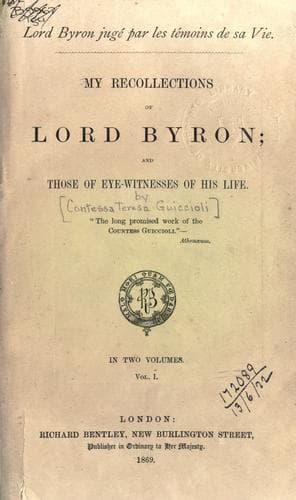
My Recollections of Lord ByronGuiccioli, Teresa, contessa di
General
My Recollections of Lord Byron
Guiccioli, Teresa, contessa di
Byron, George Gordon Byron, Baron, 1788-1824; Poets, English -- 19th century -- Biography
Whether Dallas be right or not in speaking thus of "Don Juan," we do not
wish here to examine. In quoting his words, my sole desire is to declare
that, until the appearance of this poem, Lord Byron's muse had been,
even for a Dallas, the _chaste muse of Albion_. This avowal from such a
man is worthy of note, and renders unnecessary any other quotation.
We must not, however, pass over in silence Mr. Galt's very remarkable
opinion on this subject:--
"Certainly," says he, "there are some very fine compositions on love in
Lord Byron's works, but there is not a _single line_ among the thousand
he wrote which shows a _sexual_ sentiment. With him, all breathes the
_purest_ voluptuousness. All is vague as regards love, and _without
material passion_, except in the delicious rhythm of his verses."
And elsewhere he says:--
"It is most singular that, with all his tender, passionate apostrophes
to love, Lord Byron _should not once have associated it with sensual
images_. Not even in 'Don Juan,' where he has described voluptuous
beauties with so much elegance."
Then, quoting from "Hebrew Melodies,"----
SHE WALKS IN BEAUTY.
She walks in beauty, like the night
Of cloudless climes and starry skies;
And all that's best of dark and bright
Meet in her aspect and her eyes:
Thus mellow'd to that tender light
Which heaven to gaudy day denies.
One shade the more, one ray the less,
Had half impair'd the nameless grace
Which waves in every raven tress,
Or softly lightens o'er her face;
Where thoughts serenely sweet express
How pure, how dear their dwelling-place.
And on that cheek, and o'er that brow,
So soft, so calm, yet eloquent,
The smiles that win, the tints that glow,
But tell of days in goodness spent,
A mind at peace with all below,
A heart whose love is innocent!
"Behold in these charming lines," continues Galt, "a perfect sample of
his _ethereal admiration_, his _immaterial_ enthusiasm.
"The sentiment contained in this fine poetry," says he, "beyond all
doubt belongs to the highest order of intellectual beauty;" and it
seemed proved to him that love, in Lord Byron, was rather a metaphysical
conception than a sensual passion. He remarked that even when Lord
Byron recalls the precocious feelings of his childhood toward his little
cousins--feelings so strong as to make him lose sleep, appetite, peace;
when he describes them, still unable to explain them--we feel that they
were passions much more ethereal with him than with children in general.
Public-domain text, read in full here on John Shaqi.
Reviews
Reviews
No reviews yet
Be the first to share your thoughts on this work.
Elsewhere in the archive
Join the Discussion
Join the discussion
Sign in to leave a comment or review.
Sign InorCreate an account