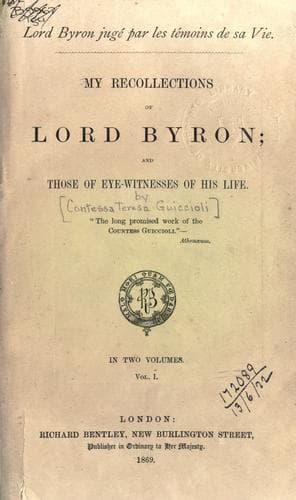
My Recollections of Lord ByronGuiccioli, Teresa, contessa di
General
My Recollections of Lord Byron
Guiccioli, Teresa, contessa di
Byron, George Gordon Byron, Baron, 1788-1824; Poets, English -- 19th century -- Biography
Indeed Monsieur Nisard evidently only speaks of the Medoras, Zuleikas,
Leilas, and in general of all the types in his Eastern poems, and
appertaining to his first period: most fascinating beings undoubtedly,
true emanations of the purest and most passionate love, but yet as
morally inferior to the Angiolinas, Myrrhas, Josephines, Auroras, as his
poems of the first period are intellectually inferior to those of the
second, beginning with the third canto of "Childe Harold," and as
civilized Christian woman is superior to a woman in the harem. But
Monsieur Nisard, who has a very systematic way of judging
things--wishing to prove that Lord Byron's loves were quite lawless in
their ungovernable strength, filling the whole soul to the absorption of
every other sentiment and interest (which might, indeed, perhaps be said
of the personages in his Eastern poems), and not able, without
contradicting himself, to assert the same as regards the love and
devotion shown by the heroic Myrrhas and virtuous Angiolinas, and other
dramatic types, all so different one from the other--has been obliged to
omit all mention of them, thus sharing an error common to vain, ignorant
critics. Yet these delightful creatures all resemble each other in the
one faculty of _loving passionately and chastely_, for that is a quality
which constitutes the very essence of woman, and Lord Byron's own
qualities must always have drawn it out in her. But there is something
far beyond beauty and passion in these noble and heroic creations of his
second manner.
"Where shall we find," says Sir Edward Bulwer Lytton, "a purer, higher
character than that of Angiolina, in the 'Doge of Venice?' Among all
Shakspeare's female characters there is certainly not one more true, and
not only true and natural, which would be slight merit, but true as a
type of the highest, rarest order in human nature. Let us stop here for
a moment, we are on no common ground; the character of Angiolina has not
yet been understood."
Bulwer then quotes the scene between Marian and Angiolina, and after
having pointed out its moral beauty, exclaims:--
"What a deep sentiment of the dignity of virtue! Angiolina does not even
conceive that she can be suspected, or that the insult offered her
required any other justification than the indignation of public
opinion."
And Bulwer goes on to quote the verses where Marian asks Angiolina if,
when she gave her hand to a man of age so disproportioned, and of a
character so opposite to her own, she loved this spouse, this friend of
her family; and whether, before marriage, her heart had not beat for
some noble youth more worthy to be the husband of beauty like hers; or
whether since, she had met with some one who might have aspired to her
lovely self. And after Angiolina's admirable reply, Bulwer says:--
Public-domain text, read in full here on John Shaqi.
Reviews
Reviews
No reviews yet
Be the first to share your thoughts on this work.
Elsewhere in the archive
Join the Discussion
Join the discussion
Sign in to leave a comment or review.
Sign InorCreate an account