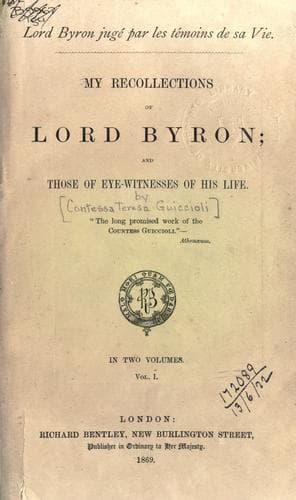
My Recollections of Lord ByronGuiccioli, Teresa, contessa di
General
My Recollections of Lord Byron
Guiccioli, Teresa, contessa di
Byron, George Gordon Byron, Baron, 1788-1824; Poets, English -- 19th century -- Biography
"Is not this conception equal at least to that of Desdemona? Is not her
heart equally pure, serene, tender, and at the same time passionate, yet
with love, not material but _actual_, which, according to Plato, gives a
visible form to virtue, and then admits of no other rival. Yet this
sublime noble woman had no cold stiffness in her nature; she forgives
Steno, but not from the cold height, of her chastity.
"'If,' said she to the indignant page, 'oh! if this false and light
calumniator were to shed his blood on account of this absurd calumny,
never from that moment would my heart experience an hour's happiness,
nor enjoy a tranquil slumber.'"
"Here," says Bulwer, "the reader should remark with what delicate
artifice the tenderness of sex and charity heighten and warm the snowy
coldness of her ethereal superiority. What a union of all woman's finest
qualities! Pride that disdains calumny; gentleness that forgives it!
Nothing can be more simply grand than the whole of this character, and
the story which enhances it. An old man of eighty is the husband of a
young woman, whose heart preserves the calmness of purity; no love
episode comes to disturb her serene course, no impure, dishonorable
jealousy casts a shade on her bright name. She treads her path through
a life of difficulties, like some angelic nature, though quite human by
the form she wears."
Wishing only to call attention to the beauty of the female characters he
created, without reference to the other beauties contained in the work,
we shall continue to quote Bulwer for the second of these admirable
creations of womankind in his dramas, namely, Myrrha. After having
praised that magnificent tragedy "Sardanapalus," he adds:--
"But the principal beauty of this drama is the conception of Myrrha.
This young Greek slave, so tender and courageous, in love with her lord
and master, yet sighing after her liberty; adoring equally her natal
land and the gentle barbarian: what a new and dramatic combination of
sentiments! It is in this conflict of emotions that the master's hand
shows itself with happiest triumph.
Public-domain text, read in full here on John Shaqi.
Reviews
Reviews
No reviews yet
Be the first to share your thoughts on this work.
Elsewhere in the archive
Join the Discussion
Join the discussion
Sign in to leave a comment or review.
Sign InorCreate an account