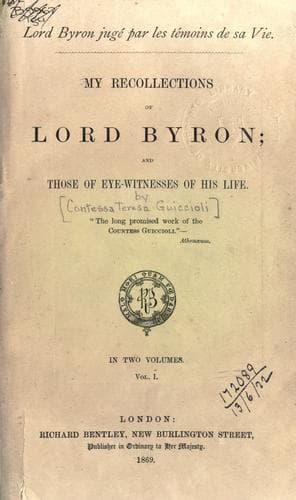
My Recollections of Lord ByronGuiccioli, Teresa, contessa di
General
My Recollections of Lord Byron
Guiccioli, Teresa, contessa di
Byron, George Gordon Byron, Baron, 1788-1824; Poets, English -- 19th century -- Biography
But enough of quotations; and now what poet has ever written or spoken
of love with words and images more chaste, more truly welling from his
own heart? We feel that he has given us the key to that. And if, after
all these demonstrations, there still remain any readers who continue to
accept as true the pleasantries, satires, and mystifications contained
in some of his verses, I do not pretend to write for them. They are to
be pitied, but there is no hope of convincing them. That depends on
their quality of mind. The only thing possible, then, is to recall some
of those anecdotes which, while justifying them in a measure, yet at the
same time illustrate Lord Byron's way of acting. I will select one. When
Lord Byron was at Pisa a friend of Shelley's, whom he sometimes saw, had
formed a close intimacy with Lady B----, a woman of middle-age but of
high birth. The tie between them was evidently the result of vanity on
Mr. M----'s side, and, as she was the mother of a large family, it was
doubly imperative on her to be respectable. But that did not prevent Mr.
M---- from boasting of his success, and even (that he might be believed)
from going into disgusting details in his eagerness for praise.
One day that Mr. M---- was in the same _salon_ (at Mrs. Sh----'s house)
with Lord Byron and the Countess G----, the conversation turned upon
women and love in general, whereupon Mr. M---- lauded to the skies the
devotedness, constancy, and truth of the sex. When he had finished his
sentimental "tirade," Lord Byron took up the opposite side, going on as
Don Juan or Childe Harold might. It was easy to see he was playing a
part, and that his words, partly in jest, partly ironical, did not
express his thoughts. Nevertheless they gave pain to Mme. G----, and, as
soon as they were alone, Lord Byron having asked her why she was sad,
she told him the cause.
"I am very sorry to have grieved you," said he, "but how could you think
that I was talking seriously?"
"I did not think it," she said, "but those who do not know you will
believe all; M---- will not fail to repeat your words as if they were
your real opinions; and the world, knowing neither him nor you, will
remain convinced that he is a man full of noble sentiments, and you a
real Don Juan, not indeed your own charming youth, but Moliere's Don
Juan!"
"Very probably," said Lord Byron; "and that will be another true page to
add to M----'s note-book. I can't help it. I couldn't resist the
temptation of punishing M---- for his vanity. All those eulogiums and
sentimentalities about women were to make us believe how charming they
had always been toward him, how they had always appreciated his merits,
and how passionately in love with him Lady B---- is now. My words were
meant to throw water on his imaginary fire."
Alas! it was on such false appearances that they made up, then and
since, the Lord Byron still believed in by the generality of persons.
Public-domain text, read in full here on John Shaqi.
Reviews
Reviews
No reviews yet
Be the first to share your thoughts on this work.
Elsewhere in the archive
Join the Discussion
Join the discussion
Sign in to leave a comment or review.
Sign InorCreate an account