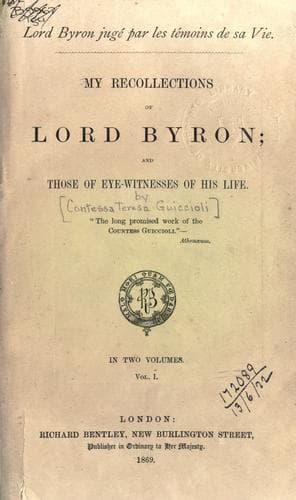
My Recollections of Lord ByronGuiccioli, Teresa, contessa di
General
My Recollections of Lord Byron
Guiccioli, Teresa, contessa di
Byron, George Gordon Byron, Baron, 1788-1824; Poets, English -- 19th century -- Biography
Lord Byron by his marriage gave another pledge of having renounced the
foibles of the heart and the allurements of the senses; and it is very
certain that he redeemed his word. If, through susceptibility or any
other defect, Lady Byron, going back to the past or trusting to vile,
revengeful, and interested spies, did not know how to understand him,
all Lord Byron's friends did, whether or not they dared to say so. And
he himself, who never could tell a lie, has assured us of his married
fidelity.[51] His life in Switzerland was devoted to study, retreat, and
even austerity. How little this stood him in stead with his enemies is
well known. "I never lived in a more edifying manner than at Geneva," he
said to Mr. Medwin. "My reputation has not gained by it. Nevertheless,
when there is mortification, there ought to be a reward."[52]
When he arrived at Milan many ladies belonging to the great world were
most anxious to know him; these presentations were proposed to him, and
he refused. As to his life at Venice, a wicked sort of romance has been
made of it, by exaggerating most ordinary things, and heaping invention
upon invention; but this has been explained with sufficient detail in
another chapter, where all the different causes of these exaggerations
have been shown in their just measure of truth.[53]
Here, then, I will only say, that if, on arriving at Venice, he relaxed
his austerity to lead the life common to young men without legitimate
ties: if, under the influence of that lovely sky, he did not remain
insensible to the songs of the beautiful Adriatic siren, nor trample
under foot the few flowers fate scattered on his path, to make amends
perhaps for the thorns that had so long beset it; if he sometimes
accepted distractions in the form of light pleasures, as well as in the
form of study,[54] did he not likewise always impose hard laborious
occupation upon his mind, thus chaining it to beautiful immaterial
things? Did his intellectual activity slacken? Was his soul less
energetic, less sublime? The works of genius that issued from his pen at
Venice are a sufficient reply. "Manfred," conceived on the summit of the
Alps, was written at Venice; the fourth canto of "Childe Harold" was
conceived and written at Venice. The "Lament of Tasso," "Mazeppa," the
"Ode to Venice," "Beppo" (from his studies of Berni), the first two
cantos of "Don Juan," were all written at Venice.
Moreover, it was there he collected materials for his dramas; there he
studied the Armenian language, making sufficient progress to translate
St. Paul's Epistles into English. And all that, in less than twenty-six
months, including his journeys to Rome and to Florence. Let moralists
say whether a man steeped in sensual pleasures could have done all that.
Public-domain text, read in full here on John Shaqi.
Reviews
Reviews
No reviews yet
Be the first to share your thoughts on this work.
Elsewhere in the archive
Join the Discussion
Join the discussion
Sign in to leave a comment or review.
Sign InorCreate an account