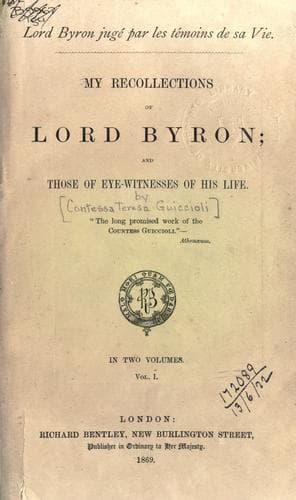
My Recollections of Lord ByronGuiccioli, Teresa, contessa di
General
My Recollections of Lord Byron
Guiccioli, Teresa, contessa di
Byron, George Gordon Byron, Baron, 1788-1824; Poets, English -- 19th century -- Biography
"A calm inquirer might, perhaps, have suspected that abandoned
profligacy is not very compatible with severe study, and that an author
is seldom loose in his life, even if he be licentious in his writings.
A calm inquirer might, perhaps, have been of opinion that a solitary
sage may be the antagonist of a priesthood without absolutely denying
the existence of a God; but there never are calm inquirers. The world,
on every subject, however unequally, is divided into parties; and even
in the case of Herbert (Lord Byron) and his writings, those who admired
his genius and the generosity of his soul were not content with
advocating, principally out of pique to his adversaries, his extreme
opinions on every subject--moral, political, and religious. Besides, it
must be confessed, there was another circumstance almost as fatal to
Herbert's character in England as his loose and heretical opinions. The
travelling English, during their visits to Geneva, found out that their
countryman solaced or enlivened his solitude by unhallowed ties. It is a
habit to which very young men, who are separated from or deserted by
their wives, occasionally have recourse. Wrong, no doubt, as most things
are, but, it is to be hoped, venial; at least in the case of any man who
is not also an atheist. This unfortunate mistress of Herbert was
magnified into a _seraglio_; extraordinary tales of the voluptuous life
of one who generally _at his studies outwatched the stars_, were rife in
English society; and
'Hoary marquises and stripling dukes,'
who were either _protecting opera-dancers_, or, still worse, _making
love to their neighbors' wives_, either looked grave when the name of
Herbert (Lord Byron) was mentioned in female society, or affectedly
confused, as if they could a tale unfold, if they were not convinced,
that the sense of propriety among all present was infinitely superior to
their sense of curiosity."
In addition to all the proofs given by the varied uses Lord Byron made
of his intellect we must not omit those furnished by the state of his
heart. If, too readily yielding at Venice to momentary and fleeting
attractions, Lord Byron had been led to squander the powers of youth, to
wish to extinguish his senses in order to open out a more vast horizon
to his intelligence; if, thus mistaking the means, he had, nevertheless,
weakened, enervated, degraded himself, would not his heart have been the
first victim sacrificed on the altar of light pleasures?
But, on the contrary, this heart which he had never succeeded in lulling
into more than a slumber, when the hour of awakening came, held dominion
by its own natural energy over the proud aspirations of his
intelligence, and found both his youth and faculty of loving unweakened,
and that he had a love capable of every sacrifice, a love as fresh as in
his very spring-tide.
Public-domain text, read in full here on John Shaqi.
Reviews
Reviews
No reviews yet
Be the first to share your thoughts on this work.
Elsewhere in the archive
Join the Discussion
Join the discussion
Sign in to leave a comment or review.
Sign InorCreate an account