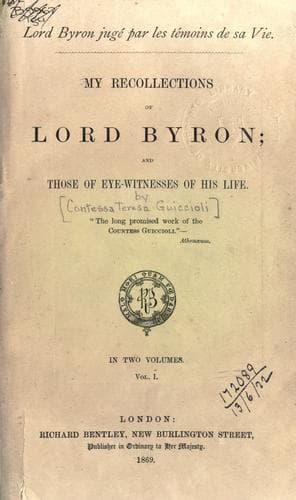
My Recollections of Lord ByronGuiccioli, Teresa, contessa di
General
My Recollections of Lord Byron
Guiccioli, Teresa, contessa di
Byron, George Gordon Byron, Baron, 1788-1824; Poets, English -- 19th century -- Biography
Are such metamorphoses possible to withered souls? Moralists have never
met with a like phenomenon. On the contrary, they certify that in hearts
withered by the enjoyments of sense all generous feelings, all noble
aspirations become extinct.
If Lord Byron's anti-sensuality were not sufficiently proved by his
actions, words, writings, and by the undeniable testimony of those who
knew him, it might still be abundantly proved by his habits of life, and
all his tastes; to begin with his sobriety, which really was wonderful.
So much so, that if the proverb, _Tell me what you eat, and I will tell
you what you are_, be true, and founded on psychological observation,
one must admit that Lord Byron was almost an immaterial being.
His fine health, his strong and vigorous constitution, lead to the
presumption that, at least in childhood and during his boyish days, his
rule of life could not have differed from that of the class to which he
belonged. Nevertheless, his sobriety was remarkable even in early youth;
at eighteen he went with a friend, Mr. Pigott, to Tunbridge Wells, and
this gentleman says, "We retired to our own rooms directly after dinner,
for Byron did not care for drinking any more than myself."
But this natural sobriety became soon after the sobriety of an
anchorite, which lasted more or less all his life, and was a perfect
phenomenon. Not that he was insensible to the pleasures of good living,
and still less did he act from any vanity (as has been said by some
incapable of sacrificing the bodily appetites to the soul); his conduct
proceeded from the desire and resolution of making _matter_ subservient
to the _spirit_.
His rule of life was already in full force when he left England for the
first time. Mr. Galt, whom chance associated with Lord Byron on board
the same vessel bound from Gibraltar to Malta, affirms that Lord Byron,
during the whole voyage, seldom tasted wine; and that, when he did
occasionally take some, it was never more than half a glass mixed with
water. He ate but little; and never any meat; only bread and vegetables.
He made me think of the ghoul taking rice with a needle."
On board "La Salsette," returning from Constantinople, he himself wrote
to his friend and preceptor Drury, that the gnats which devoured the
_delicate body_ of Hobhouse had not much effect on him, because he lived
in a _more sober manner_.
As to his mode of living during his two years' absence from England we
can say nothing, except that he lived in climates where sobriety is the
rule, and that his letters expressed profound disgust at the complaints,
exacting tone, and effeminate tastes of his servants, and his own
preference for a monastic mode of life, and very probably also for
monastic diet. The testimony to his extraordinary sobriety becomes
unanimous as soon as he returns home.
Dallas, who saw him immediately on his landing in 1811, writes:--
Public-domain text, read in full here on John Shaqi.
Reviews
Reviews
No reviews yet
Be the first to share your thoughts on this work.
Elsewhere in the archive
Join the Discussion
Join the discussion
Sign in to leave a comment or review.
Sign InorCreate an account