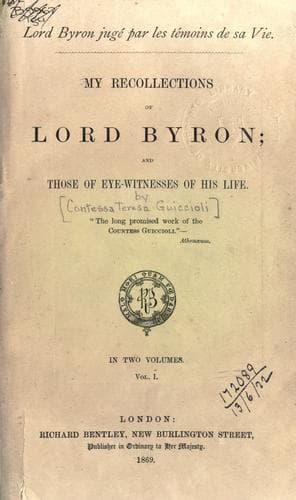
My Recollections of Lord ByronGuiccioli, Teresa, contessa di
General
My Recollections of Lord Byron
Guiccioli, Teresa, contessa di
Byron, George Gordon Byron, Baron, 1788-1824; Poets, English -- 19th century -- Biography
But to acknowledge all these things, or even any thing extraordinarily
good in the author of "Don Juan," the "Age of Bronze," the "Vision;" in
a son so _wanting in respect_ for the weaknesses of his mother-country;
in a poet that had dared to chastise powerful enemies, and the limit of
whose audacity was not even yet known, for his death had just condemned,
through revelations and imprudent biographies, many persons and things
to a sorry kind of immortality; to praise him, declare him guiltless, do
him justice,--truly that would have been asking too much from England at
that time. England has since made great strides in the path of generous
toleration and even toward justice to Lord Byron. For vain is calumny
after a time: truth destroys calumny by evoking facts. These form a
clear atmosphere, wherein truth becomes luminous, as the sun in its
atmosphere: for facts give birth to truth, and are mortal to calumny.
FOOTNOTES:
[Footnote 42: The history of the page is, however, true. Lord Byron was
then nineteen years of age. Not to give his mother the grief of seeing
that he had made an acquaintance she would have disapproved, he brought
Miss ---- from Brighton to the Abbey, dressed as a page, that she might
pass for her brother Gordon.]
[Footnote 43: See "Newstead Abbey," by Washington Irving.]
[Footnote 44: Moore, vol. i. p. 346.]
[Footnote 45: See Galt, "Life of Lord Byron."]
[Footnote 46: See chapter on "Generosity."]
[Footnote 47: See "Life in Italy."]
[Footnote 48: The heroism of the young Zuleika, says Mr. G. Ellis in his
criticism, is full of purity and loveliness. Never was a more perfect
character traced with greater delicacy and truth; her piety,
intelligence, her exquisite sentiment of duty and her unalterable love
of truth seem born in her soul rather than acquired by education. She is
ever natural, seductive, affectionate, and we must confess that her
affection for Selim is well placed.]
[Footnote 49: "Childe Harold," canto iv. stanza 177.]
[Footnote 50: See "Don Juan," canto xvi.]
[Footnote 51: See chapter on Marriage.]
[Footnote 52: Medwin, p. 13.]
[Footnote 53: See "Life in Italy."]
[Footnote 54: Ibid.]
[Footnote 55: Moore, vol. ii, p. 182.]
[Footnote 56: See "Life in Italy," at Venice.]
[Footnote 57: See "Life in Italy."]
[Footnote 58: Dallas, 171.]
[Footnote 59: Moore, 315.]
[Footnote 60: Moore, first vol.]
[Footnote 61: Moore, 315.]
[Footnote 62: See "Life in Italy."]
[Footnote 63: "He was more a mental being, if I may use this phrase,"
said Captain Parry, who knew him at Missolonghi, "than any one I ever
saw; he lived on thoughts more than on food."]
CHAPTER XI.
THE CONSTANCY OF LORD BYRON.
Public-domain text, read in full here on John Shaqi.
Reviews
Reviews
No reviews yet
Be the first to share your thoughts on this work.
Elsewhere in the archive
Join the Discussion
Join the discussion
Sign in to leave a comment or review.
Sign InorCreate an account