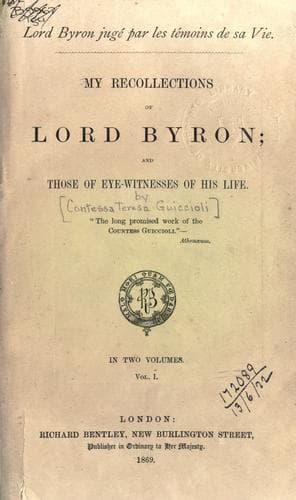
My Recollections of Lord ByronGuiccioli, Teresa, contessa di
General
My Recollections of Lord Byron
Guiccioli, Teresa, contessa di
Byron, George Gordon Byron, Baron, 1788-1824; Poets, English -- 19th century -- Biography
Among Lord Byron's moral virtues, may we count that of constancy? Men in
general, not finding this virtue in their own lives, refuse to believe
in its existence among those who, in exception to the common rule, do
possess it. They must be forced to this act of justice as to many
others. This is comprehensible; constancy is so rare!
"I less easily believe constancy in men than any thing else," says
Montaigne, "and nothing more easily than inconstancy."
Besides the difficulties common to every one, Lord Byron had also to
fight against those difficulties peculiar to his sensitive nature and
his vast intelligence.
"The largest minds," says Bacon, "are the least constant, because they
find reasons for deliberating, where others only see occasion for
acting."
But if these difficulties overcame Lord Bacon's constancy, could they
have the same power over Lord Byron, who was indeed his equal in mind,
but his opposite in conduct and strength of soul? There are three sorts
of constancy: that of affection, which has its source in goodness of
heart; that of taste, flowing from beauty of soul; that of idea, derived
from rectitude of intelligence.
Did Lord Byron possess the whole of these, or only a part? As this may
be chiefly proved, not from writings or words, but by conduct, let us
ask the question of those who knew him personally and at all periods of
his life.
Was he constant in his ideas? Moore, speaking of Lord Byron's
intellectual faculties, of his variableness, of which he makes too much,
for the reasons I have mentioned,[64] and of the danger to which it
exposed his consistency and oneness of character, says:--
"The consciousness, indeed, of his own natural tendency to yield thus to
every chance impression, and change with every passing impulse, was not
only forever present to his mind, but, aware as he was of the suspicion
of weakness attached by the world to any retractation or abandonment of
long-professed opinions, had the effect of keeping him in that general
line of consistency, on certain great subjects, which, notwithstanding
occasional fluctuations and contradictions as to the details of these
very subjects, he continued to preserve throughout life. A passage from
one of his manuscripts will show how sagaciously he saw the necessity of
guarding himself against his own instability in this respect:--'The
world,' he says, 'visits change of politics or change of religion with a
more severe censure than a mere difference of opinion would appear to me
to deserve. But there must be some reason for this feeling, and I think
it is that this departure from the earliest instilled ideas of our
childhood, and from the line of conduct chosen by us when we first enter
into public life, have been seen to have more mischievous results for
society, and to prove more weakness of mind than other actions, in
themselves more immoral.'"
Public-domain text, read in full here on John Shaqi.
Reviews
Reviews
No reviews yet
Be the first to share your thoughts on this work.
Elsewhere in the archive
Join the Discussion
Join the discussion
Sign in to leave a comment or review.
Sign InorCreate an account