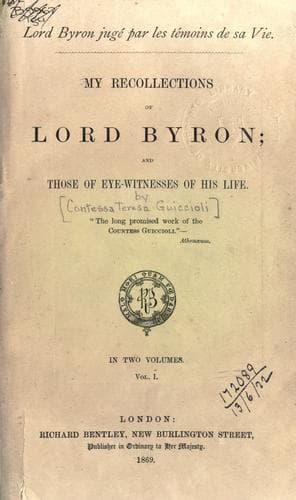
My Recollections of Lord ByronGuiccioli, Teresa, contessa di
General
My Recollections of Lord Byron
Guiccioli, Teresa, contessa di
Byron, George Gordon Byron, Baron, 1788-1824; Poets, English -- 19th century -- Biography
"To superficial observers," says the Hon. Col. Stanhope, "his conduct
might appear uncertain; and that was the case sometimes, but only _up to
a certain point_. His genius was limitless and versatile, and in
conversation he passed boldly from grave to gay, from light to serious
topics; but nevertheless, _upon the whole and in reality_, no man was
more constant, I might almost say _more obstinate_, than Lord Byron _in
the pursuit of great objects_. For instance, in religion and in
politics, he seemed as firm as a rock, though, like a rock, he was
sometimes subject to great shocks, to the convulsions of nature in
commotion. What I affirm is, that Lord Byron had very fixed opinions on
important matters. It is not from the opinion he wished to give of
himself, nor from what he allowed to escape his lips, that I could have
drawn this conclusion; for, in conversing with me on politics or
religion, and passing capriciously over this latter subject, sometimes
laughing and making strings of jests, he would say, for instance, '_the
more I think the more I doubt--I am a thorough skeptic_;' but I find
these words contradicted in _all his actions, and in all his sentiments
seriously expressed from childhood to death_. And I opine that although
occasionally he may have appeared changeable, still he always came back
to certain fixed ideas in his mind; that he always entertained a
constant attachment to liberty according to his notions of liberty; and
that, although not orthodox in religion, he _firmly believed_ in the
existence of a God. It is then equally false to represent him as an
atheist or as an orthodox Christian. Lord Byron was, as he often told
me, _a thorough deist_."[65]
It would be easy to prove in a thousand ways that, despite the danger of
inconstancy resulting from his great sensibility, imagination, and
intellect, no one, more than Lord Byron, steadily and firmly adhered
_through life_ in his actions to the principles which _constitute the
man of honor_. Chances, caprices, inequalities of temper, which are to
sensitive natures what bubbles are on a lake, all disappeared when these
great principles required to be acted upon; and the effects even of his
well-nigh inexhaustible benevolence were checked, if he had to struggle
against his principles. We find in his memoranda, 1813:--"I like George
Byron" (his cousin, the present lord); "I like him much more than one
generally does one's heirs. He is a fine fellow. I would do any thing to
see him advance in his career as a sailor; _any thing except
apostatize_!" (Lord Byron was a _Whig_, and his cousin a _Tory_.)
Public-domain text, read in full here on John Shaqi.
Reviews
Reviews
No reviews yet
Be the first to share your thoughts on this work.
Elsewhere in the archive
Join the Discussion
Join the discussion
Sign in to leave a comment or review.
Sign InorCreate an account