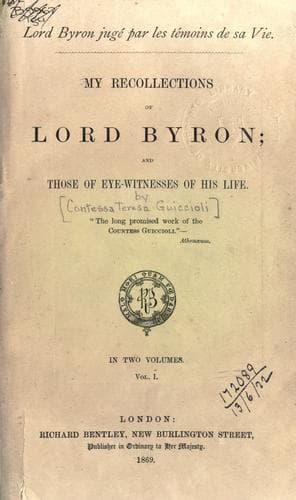
My Recollections of Lord ByronGuiccioli, Teresa, contessa di
General
My Recollections of Lord Byron
Guiccioli, Teresa, contessa di
Byron, George Gordon Byron, Baron, 1788-1824; Poets, English -- 19th century -- Biography
At fifteen years of age, while at Harrow, he fought with Lord Calthorpe
for calling him an _atheist_; at eighteen, he wrote his beautiful
profession of faith in the Prayer to the Divinity, and in the touching
"Adieu," which he wrote when he thought he would soon die. At nineteen,
giving the list in his memoranda of books already read (a list hardly
credible), he says: "With regard to books on religion, I have read
Blair, Porteous, Tillotson, Hooker,--all very tiresome. I detest books
about religion, but I adore and love my God, apart from the blasphemous
notions of sectarians, and without believing in their absurd and
damnable heresies, mysteries, etc." At twenty-one, when he had passed
through the double influence exercised by Pagan classical literature and
German philosophies, and was in a transition state, he wrote "Childe
Harold;" but the skeptical tendencies to be found in one stanza appear
like a bravado, the result of spleen, a feeling that made him suffer,
and which he speedily threw aside. For he wrote, at the same time, the
stanza upon the death of a friend, whom he _hopes to see again in the
land of souls_, and afterward, the elegies to Thyrza, which are full of
_faith in immortality_. At thirty, writing some philosophical
reflections in his memorandum-book, he says: "One can not doubt the
immortality of the soul."
And, elsewhere, he also says that Christianity appears to him
essentially founded on the immateriality of the soul, and that, for this
reason, the Christian materialism of Priestley had always struck him as
being a deadly sort of doctrine. "Believe, if you please," added he, "in
the material resurrection of the body, but not without a soul: it would
be cruel indeed, if, after having had a soul in this world (and our
mind, by whatever name you call it, is really a soul), we were to be
separated from it in the other, even for material immortality! I confess
my partiality for mind."
Alluding to the systems of philosophy that do not admit creation
according to Genesis, he says, that "even if we could get rid of Adam
and Eve, of the apple and the serpent, we should not know what to put in
their place; that the difficulty would not be overcome; that things must
have had a beginning, it matters not when and how; that creation must
have had an origin and a Creator. For creation is much more natural and
easy to imagine than a concurrence of atoms; that all things may be
traced to their sources even though they end by emptying themselves into
an ocean."
We have seen what he said to Parry upon religion[69] and its ministers,
upon God Almighty and the hope of enjoying eternal life, only a few
weeks before his glorious death.
Public-domain text, read in full here on John Shaqi.
Reviews
Reviews
No reviews yet
Be the first to share your thoughts on this work.
Elsewhere in the archive
Join the Discussion
Join the discussion
Sign in to leave a comment or review.
Sign InorCreate an account