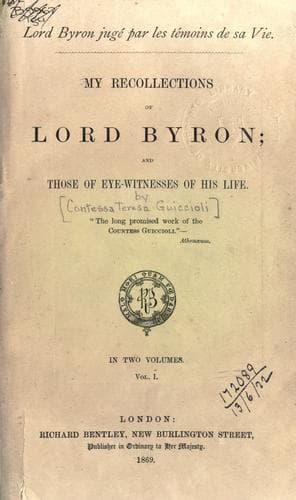
My Recollections of Lord ByronGuiccioli, Teresa, contessa di
General
My Recollections of Lord Byron
Guiccioli, Teresa, contessa di
Byron, George Gordon Byron, Baron, 1788-1824; Poets, English -- 19th century -- Biography
And when the hand of death was already upon him, a few moments before
his agony, did he not say that eternity and space were already before
his eyes, but that on this point, thanks to God, _he was happy and
tranquil?_ that the thought of living _eternally_, of living another
life, was a great consolation to him? that Christianity was the purest
and most liberal of all religions (although a little spoiled by the
ministers of Christ, often the worst enemies of its liberal and
charitable doctrines); but that, as to the questions depending on these
doctrines, and which God alone, all powerful, can determine, in Him
alone did he wish to rest?
But if Lord Byron was constant to a certain order of ideas, was he
equally constant in his affections? Moore again shall answer:--
"The same distrust in his own steadiness, thus keeping alive in him a
conscientious self-watchfulness, concurred not a little, I have no
doubt, with the innate, kindness of his nature, to preserve so constant
and unbroken the greater number of his attachments through life--some of
them, as in the instance of his mother, owing evidently more to a sense
of duty than of real affection, the consistency with which, so
creditably to the strength of his character, they were maintained."
But, putting aside family affections, where constancy may appear a duty
and a necessity, let us see what Lord Byron was in affections of his own
choice,--such as friendship and love, where inconstancy is a sin that
the world easily forgives.
We have seen what the friendship of Lord Byron meant. Death destroyed
several of the young existences with which his heart was bound up, and
his first sorrows sprang from these misfortunes. But _never_ by his
will, caprice, or fault, did he lose a single friend! Even the wrongs
they inflicted, while they weighed upon his mind, altered his opinions
sometimes, dispelled some sweet illusions and grieved his heart, yet
could not succeed in changing it. He contented himself with judging the
individual in such cases, sometimes with philosophical indulgence which
he was only too much accustomed to hide under the veil of pleasantry,
and sometimes in showing openly how much his heart was wounded.[70]
Public-domain text, read in full here on John Shaqi.
Reviews
Reviews
No reviews yet
Be the first to share your thoughts on this work.
Elsewhere in the archive
Join the Discussion
Join the discussion
Sign in to leave a comment or review.
Sign InorCreate an account