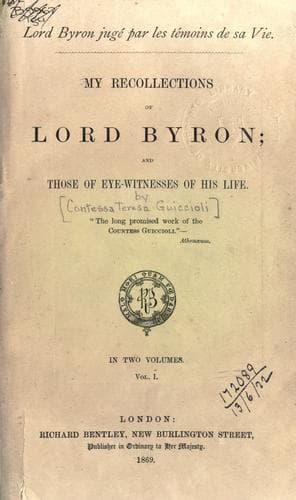
My Recollections of Lord ByronGuiccioli, Teresa, contessa di
General
My Recollections of Lord Byron
Guiccioli, Teresa, contessa di
Byron, George Gordon Byron, Baron, 1788-1824; Poets, English -- 19th century -- Biography
The first condition for judging any one impartially with regard to
inconstancy in love, is not only to know the facts and real
circumstances connected with an intimacy, but especially to know the
nature of the sentiment to which the name of love has been applied. We
are aware that, at fifteen years of age, Lord Byron's heart was already
under the influence of a young girl of eighteen.[71] The mere
disproportion of age prevents such an affection from offering any
grounds on which to examine his capability of being constant. It is well
known how much suffering this early passion caused him. The object of
it, after denying him no token of reciprocal love that was innocent,
giving him her picture, agreeing to meetings, receiving all the
spontaneous, innocent, confiding tenderness of his young and ardent
heart, left him in the lurch one fine day, on account of his youth, in
order to marry a fashionable, vulgar man. And thus did she destroy the
charm which governed his heart. Precocious reflection, with its
accompaniment of knowledge, agitating, confusing, throwing young souls
on the road to error, succeeded to his enchantment. He then began (at
sixteen) to talk of vanished illusions; and, for want of something
better, allowed himself to be carried away, and to lead the ordinary
university life. He evidently only did what others did; but he was made
of different materials; and while they thought this dissipation very
natural, and, tranquil in their inferiority, believed themselves
innocent, he alone disapproved of his own conduct and blamed it. The
better to escape all this, he went in search of forgetfulness amid the
fresh breezes of ocean, across the Pyrenees, among the ruins of ancient
civilization. Yet, after two years' travelling, on his return to
England, his soul all love, his heart burning with an infinite ardor,
through that intoxication of success which weakens, through that
eagerness for emotion caused by his vivacity of mind, and even by a sort
of psychological curiosity, Lord Byron did fall into new attachments.
And these attachments, not being of a nature that could stand the trial
of reflection, caused him to give up known for unknown objects. But his
soul was ever agitated, in commotion, and, even when he changed, it was
through necessity rather than caprice. In order to escape once more from
himself, from the allurements of the senses, from the effects of the
enthusiasm which his personal beauty and his genius excited among women,
he resolved to take refuge in an indissoluble tie, in a tie formed by
duty, not love. Perhaps he might have found strength for perseverance in
the beauty of the sacrifice. His soul was quite capable of it. But
destiny pursued him in his choice, and rendered it impossible. To his
misfortune, he married Miss Milbank.[72] Again he drifted away from the
right path, but, this time, with the resolution of keeping his heart
independent, his soul free and unfettered by any indissoluble tie.[73]
Public-domain text, read in full here on John Shaqi.
Reviews
Reviews
No reviews yet
Be the first to share your thoughts on this work.
Elsewhere in the archive
Join the Discussion
Join the discussion
Sign in to leave a comment or review.
Sign InorCreate an account