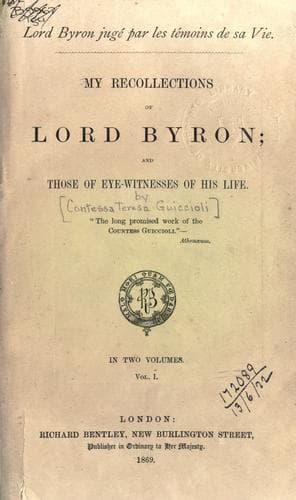
My Recollections of Lord ByronGuiccioli, Teresa, contessa di
General
My Recollections of Lord Byron
Guiccioli, Teresa, contessa di
Byron, George Gordon Byron, Baron, 1788-1824; Poets, English -- 19th century -- Biography
But in coming to this determination at the age of twenty-eight, he
had not consulted his heart, ever athirst for infinitude. Vainly
he sought to lull it, to keep it earthward, to laugh at his own
aspirations--useless labor! One day it broke loose. Nature is like
water; sooner or later it must find its equilibrium. From that day
forth Psyche's lamp had no more light; reflection had no more power; and
the love which had taken possession of his soul left him not again, but
accompanied him to his last hour, through the modifications inevitable
in earthly affections. This constancy maintained thenceforth without a
struggle, he understood at once; and felt that the unchanging sentiment
belonged equally to his will and to his destiny. "_Coelum, non animam
mutant qui trans mare currunt_," wrote he one day at Ravenna, on the
opening page of "Jacopo Ortis," Foscolo's work, that had just fallen
into his hands; for he knew that no one could read this avowal of his
heart where he had traced it. After having remarked the strange
coincidence by which this volume was brought a second time before him,
just when he was, as once before, in extreme agitation, he continued
thus:--
"Most men bewail not having attained the object of their desires. I had
oftener to deplore the obtaining mine, for I can not love moderately,
nor quiet my heart with mere fruition. The letters of this Italian
Werther are very interesting; at least I think so, but my present
feelings hardly render me a competent judge."
Another time, a volume of "Corinne," translated into Italian, fell under
his notice at Ravenna. In the same language, which no one then about him
could read, he confided to this book the secret of his heart, and, after
having poured out its fullness in words of noble melting tenderness,
concluded thus:--"Think of me when Alps and sea shall separate us; _but
that will never come to pass, unless you so will it_."
It was not willed, and therefore the separation did not take place. But,
alas! the day arrived when he was so entangled in a multiplicity of
complications, and honor spoke so loudly, that both sides were forced to
will it.
Public-domain text, read in full here on John Shaqi.
Reviews
Reviews
No reviews yet
Be the first to share your thoughts on this work.
Elsewhere in the archive
Join the Discussion
Join the discussion
Sign in to leave a comment or review.
Sign InorCreate an account