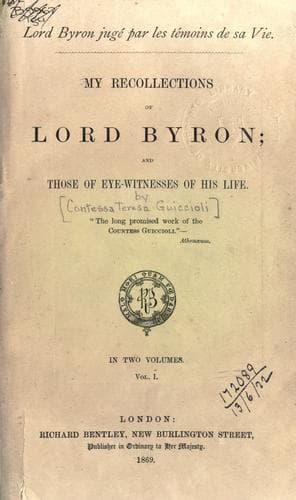
My Recollections of Lord ByronGuiccioli, Teresa, contessa di
General
My Recollections of Lord Byron
Guiccioli, Teresa, contessa di
Byron, George Gordon Byron, Baron, 1788-1824; Poets, English -- 19th century -- Biography
Perhaps also from certain critics who believed in the statements of
various calumniators, and who themselves had probably not had any better
authority than a few articles in badly informed papers, or in newspapers
politically opposed to Lord Byron. We all know, by what we see daily in
France, how little we can trust the moderation of these, and the justice
they render to their adversaries; what must it not have been in England
at that time, when passions ran so high?--Perhaps also from the jealousy
of dethroned rivals!--the echoes, perhaps, of the revenge of a woman
equally distinguished by her rank and by her talent, but whose passion
approached the boundaries of madness, or of the implacable hatred of a
few fanatics who, substituting in the most shameless manner their
worldly and sectarian interests for the Gospel, denounced him as an
atheist because he himself had proclaimed them hypocrites. Finally,
perhaps, from a host of absurd rumors, equally odious and vague, caused
by his separation from his wife, and by the articles published in
newspapers printed at Venice and at Milan.
For Byron's noble, simple, and sublime person was therefore substituted
an imaginary being, formed out of these prejudices and these
contradictory elements, too outrageous even to be believed, and by dint
of sheer malice.
Thus enveloped in a dense atmosphere, which became an obstacle to the
disclosure of truth as the clouds are to the rays of the sun, his image
only appeared in fantastical outlines borrowed from "Conrad the
Corsair," or "Childe Harold," or "Lara," or "Manfred," or indeed "Don
Juan." Analogies were sought which do not exist, and to the poet were
attributed the sentiments, and even the acts, of these imaginary beings,
albeit without any of the great qualities which constituted his great
and noble soul, and which he has not imparted to any of his poetical
creations.
Upon him were heaped every possible and most contradictory
accusation--of skepticism and pantheism, of deism and atheism, of
superstition and enthusiasm, of irony and passion, of sensuality and
ideality, of generosity and avarice. These went to form his portrait,
presenting every contrast and every antagonism, which God Himself, the
Father and Creator of all things, but also the Author of all harmony,
could not have assembled in one and the same being unless He made of him
a species of new Frankenstein, incapable of treading the ordinary paths
of physical, moral, or intellectual, nay, of the most ordinary
existence.
After thus producing such an eccentric character,--the more
extraordinary that they entirely forgot to consult the true and most
simple history of his life, where if some of the ordinary excusable
faults of youth are to be found, "some remarkable qualities, however,
must be noticed,"--these wonderful biographers exclaim, astonished as it
were at their own conclusions:--"This is indeed a most singular,
extraordinary, and not-to-be-defined being!"
Public-domain text, read in full here on John Shaqi.
Reviews
Reviews
No reviews yet
Be the first to share your thoughts on this work.
Elsewhere in the archive
Join the Discussion
Join the discussion
Sign in to leave a comment or review.
Sign InorCreate an account