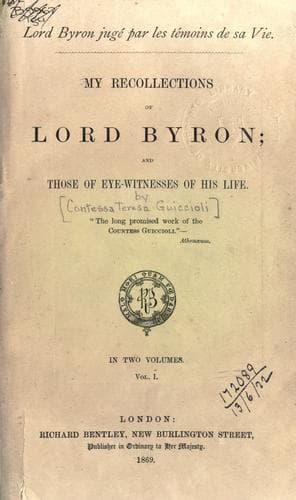
My Recollections of Lord ByronGuiccioli, Teresa, contessa di
General
My Recollections of Lord Byron
Guiccioli, Teresa, contessa di
Byron, George Gordon Byron, Baron, 1788-1824; Poets, English -- 19th century -- Biography
I should think so: it is their own work, not the noble, amiable, and
sublime mind, the work of God, and which he always exhibited in himself,
"Per far di colassa fede fra noi."--PETRARCH.
Happily, if to paint the portrait of Byron has become impossible, now
that
"Poca terra e rimasto il suo belviso,"
it is easy to describe his moral character. His invisible form is, it is
true, above, but a conscientious examination of his whole life will give
us an idea of it. He knew this so well himself, that a few days before
his death he begged, as a favor, of his friend Lord Harrington, then
Colonel Stanhope, at Missolonghi, to judge him only by his deeds. "Judge
me by my deeds."
All bombastic expressions, all systematic views should be discarded, and
attention paid only to facts, in order to discover the fine intellectual
figure of Lord Byron so completely lost sight of by his detractors.
Since the imaginary creations of his pen in moments of exalted passion
should not be taken as the real manifestation of his character, the
latter is to be found in his own deeds, and in the testimony of those
who knew him personally. Herein shall we seek truth by which we are to
deal with the fanciful statements which have too long been received as
facts. Let us consider the opinions of those who by their authority have
a right to portray him, while we study the various causes which have
contributed to lead the public into errors which time has nearly
consecrated, but which shall be corrected in France, and indeed in every
country where passion and animosity have no interest in maintaining
them.
"Public opinion," says M. Cousin, "has its errors, but these can not be
of long duration." They lasted a long time, however, as regards Lord
Byron; but, thanks to God, they will not be eternal. He depended upon
this himself, for he once at Ravenna wrote these prophetic words in a
memorandum:--
"Never mind the wicked, who have ever persecuted me with the help of
Lady Byron: triumphant justice will be done to me when the hand which
writes this is as cold as the hearts that have wounded me."
In England, Lord Byron triumphed over many jealous enemies whom his
first satire earned for him, no less than the rapid and wonderful rise
of his genius, which, instead of appearing by degrees, burst forth at
once, as it were, and towering over many established reputations. The
prestige which he acquired was such that every obstacle was surmounted,
and in one day he saw himself raised against his will, and without his
having ever sought the honor, to the highest pinnacle of fashion and
literary fame.
Public-domain text, read in full here on John Shaqi.
Reviews
Reviews
No reviews yet
Be the first to share your thoughts on this work.
Elsewhere in the archive
Join the Discussion
Join the discussion
Sign in to leave a comment or review.
Sign InorCreate an account