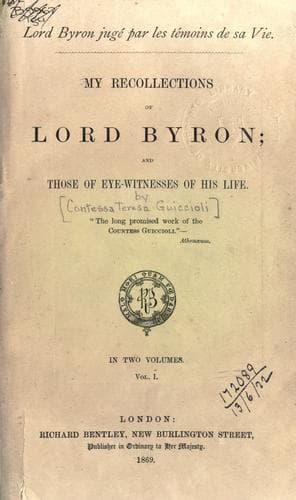
My Recollections of Lord ByronGuiccioli, Teresa, contessa di
General
My Recollections of Lord Byron
Guiccioli, Teresa, contessa di
Byron, George Gordon Byron, Baron, 1788-1824; Poets, English -- 19th century -- Biography
Between these two great minds there existed a wide gulf--that which
exists between pantheism and spiritualism; but they had one great point
of resemblance, their mutual passionate love for justice and humanity,
their hatred of cant and hypocrisy, in fact, all the elevated sentiments
of the moral and social man. With Lord Byron these noble dispositions of
the heart and mind were naturally the consequence of his tastes and
opinions, which were essentially spiritualistic. With Shelley, though in
contradiction with his metaphysics, they were notwithstanding in harmony
with the beautiful sentiments of his soul, which, when he was only
twenty-three years of age, had already experienced the unkindness of
man. Their respective souls, wounded and hurt by the perfidiousness and
injustice of the world, felt themselves attracted to each other. A real
friendship sprang up between them. They saw one another often, and it
was in the conversations which they held together at this time that the
seed was sown which shortly was to produce the works of genius which
were to see the day at the foot of the Alps and under the blue sky of
Italy.
Although Lord Byron's heart was mortally wounded, still no feeling of
hatred could find its way into it. The sorrow which he felt, the painful
knowledge which he had of cruel and perfidious wrongs done to him, the
pain of finding out the timidity of character of his friends, and the
recollection of the many ungrateful people of whom he was the victim,
all and each of these sentiments found their echo in the "Prisoner of
Chillon," in the third canto of "Childe Harold," in "Manfred," in the
pathetic stanzas addressed to his sister, in the admirable and sublime
monody on the death of Sheridan, and in the "Dream," which according to
Moore, he must have written while shedding many bitter tears. According
to the same authority, the latter poem is the most melancholy and
pathetic history that ever came forth from human pen.
Public-domain text, read in full here on John Shaqi.
Reviews
Reviews
No reviews yet
Be the first to share your thoughts on this work.
Elsewhere in the archive
Join the Discussion
Join the discussion
Sign in to leave a comment or review.
Sign InorCreate an account