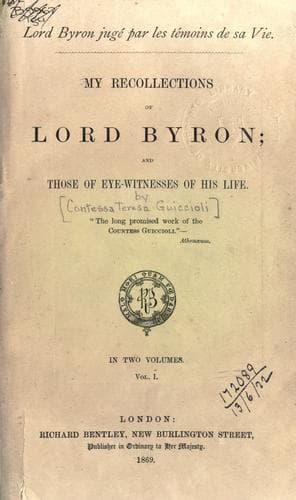
My Recollections of Lord ByronGuiccioli, Teresa, contessa di
General
My Recollections of Lord Byron
Guiccioli, Teresa, contessa di
Byron, George Gordon Byron, Baron, 1788-1824; Poets, English -- 19th century -- Biography
In a country where success is all, his enemies, and those who were
jealous of his name, were obliged to fall back; but they did not give up
their weapons nor their spite. One curious element was introduced in the
national veneration for the poet. It was agreed that never had such an
accumulation of various gifts been heaped upon the head of one man: he
was to be revered and honored, but on one condition. He was to be a
mysterious being whose genius should not transgress the boundaries of
the East; who was to allow himself to be identified with the imaginary
beings of his own fancy, however disagreeable, nay, even criminal they
might be in reality. True, his personal conduct (at twenty-four) was to
be above all human weakness; if not, he was to be treated, as certain
superstitious votaries treat their idols if they do not obtain at once
the miracles they ask for. His secret enemies perfidiously made use of
these stupid demands of the public.
Insinuating and giving out at times one calumny after another, they
always kept behind the scenes, resolved, however, to ruin him in the
public esteem on the first opportunity, which they knew they would not
have long to wait for from one so open, so passionate, so generous as
Lord Byron. The greatest misfortune of his life--his marriage--gave them
their opportunity. Then they came forth, threw down the mask which they
had hitherto worn, to put on one more hideous still; overturned the
statue from the pedestal upon which the public had raised it, and tried
to mutilate its remains. But as the stuff of which it was made was a
marble which could not be broken, they only defiled, insulted, and
outlawed it.
Then it was that France made acquaintance with Lord Byron. She saw him
first mysteriously enveloped in the romantic semblance of a Corsair, of
a skeptical Harold, of a young lord who had despised and wounded his
mother-country, from which he had almost been obliged to exile himself,
in consequence of a series of eccentricities, faults, and--who
knows?--of crimes, perhaps. Thus caught in a perfidious net, Lord Byron
left England for Switzerland.
He found Shelley, whom he only knew by name, at Geneva, where he
stopped. Shelley was another victim of English fanatical and intolerant
opinions; but he, it may be allowed at least, had given cause for this
by some reprehensible writings, in which he had declared himself an
atheist. No allowance had been made for his youth, for he was only
seventeen when he wrote "Queen Mab," and he found himself expelled not
only from the university but also from his home, which was to him a real
cause of sorrow and misfortune.
Public-domain text, read in full here on John Shaqi.
Reviews
Reviews
No reviews yet
Be the first to share your thoughts on this work.
Elsewhere in the archive
Join the Discussion
Join the discussion
Sign in to leave a comment or review.
Sign InorCreate an account