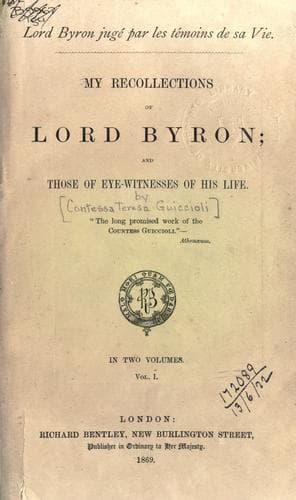
My Recollections of Lord ByronGuiccioli, Teresa, contessa di
General
My Recollections of Lord Byron
Guiccioli, Teresa, contessa di
Byron, George Gordon Byron, Baron, 1788-1824; Poets, English -- 19th century -- Biography
and sent her back several of her letters sealed up. "Glenarvon" was her
revenge. She painted Byron in fiendish colors, giving herself all the
qualities he possessed, so as to appear an angel, and to him all the
passions of the "Giaour," of the "Corsair," and of "Childe Harold," so
that he might be taken for a demon.
In this novel, the result of revenge, truth asserts its rights,
notwithstanding all the contradictions of which the book is full. Thus
Lady L---- can not help depicting Byron under some of his real
characteristics. She was asked, for instance, what she thought of him,
when she met him for the first time after hearing of his great
reputation, and she answers, while gazing at the soft loveliness of his
smile,--
"What do I think? I think that never did the hand of God imprint upon a
human form so lovely, so glorious an expression."
And further she adds:--
"Never did the Sculptor's hand, in the sublimest product of his talent,
imagine a form and a face so exquisite, so full of animation or so
varied in expression. Can one see him without being moved? Oh! is there
in the nature of woman the possibility of listening to him, without
cherishing every word he utters? and having listened to him once, is it
possible for any human heart ever to forget those accents which awaken
every sentiment and calm every fear?"
Again:--
"Oh better far to have died than to see or listen to Glenarvon. When he
smiled, his smile was like the light of heaven; his voice was more
soothing from its softness than the softest music. In his manner there
was such a charm, that it would have been vain to affect even to be
offended by its sweetness."
But while she was obliged to obey the voice of passion and of truth, she
took on the other hand as a motto to her novel that of the "Corsair,"
which even applied to the "Corsair" is not altogether just, for he was
gifted with more than "one virtue:--"
"He left a Corsair's name to other times,
Link'd with one virtue and a thousand crimes."
It is, however, fair to add, that this revenge became the punishment of
the heroine; she never again found any rest, struggled against a
troubled mind, and never succeeded in forgetting her love. It is even
said that, diseased in mind and body, she was one day walking along one
of the alleys of her beautiful place, on the road to Newstead Abbey,
when she saw a funeral procession coming up the road in the direction of
Newstead. Having inquired whose funeral it was, and being told it was
that of the great poet, whose mortal remains were being conveyed to
their last resting-place, she fainted, and died a few days afterward.
His name was the last word she uttered, and this she did with love and
despair. In London, and wherever the authoress was known, the book had
no success, but the case was different abroad and in the provinces.
Public-domain text, read in full here on John Shaqi.
Reviews
Reviews
No reviews yet
Be the first to share your thoughts on this work.
Elsewhere in the archive
Join the Discussion
Join the discussion
Sign in to leave a comment or review.
Sign InorCreate an account