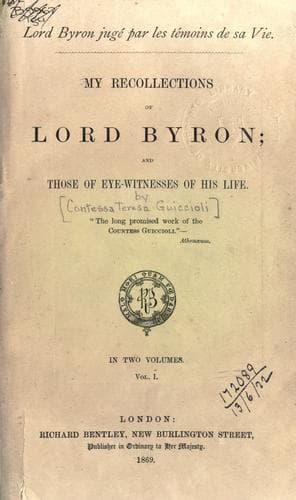
My Recollections of Lord ByronGuiccioli, Teresa, contessa di
General
My Recollections of Lord Byron
Guiccioli, Teresa, contessa di
Byron, George Gordon Byron, Baron, 1788-1824; Poets, English -- 19th century -- Biography
Attracted as he always was toward all that is good, great, and sincere,
Byron was wont to break the monotony of his retired life in the villa
Diodati by frequent visits to Madame de Stael at her country-seat,
"Coppet." She was the first who mentioned "Glenarvon" to him, and when
Murray wrote to him on the subject, Byron simply replied,--
"Of Glenarvon, Madame de Stael told me (ten days ago at Coppet)
marvellous and grievous things; but I have seen nothing of it but the
motto, which promises amiably 'for us and for our tragedy' ... 'a name
to all succeeding,' etc. The generous moment selected for the
publication is probably its kindest accompaniment, and, truth to say,
the time _was_ well chosen."[11]
"I have not even a guess at its contents," said he, and he really
attached no importance to its publication. But a few days later he had a
proof of the bad effect which its appearance had produced, for all this
venom against him had so poisoned the mind of a poor old woman of
sixty-three, an authoress, that on Lord Byron entering Madame de Stael's
drawing-room one afternoon, she fainted, or feigned to do so. Poor soul!
a writer of novels herself, and probably most partial to such reading,
she had, no doubt, from the perusal of "Glenarvon" gleaned the idea that
she had before her eyes that hideous monster of seduction and
perpetrator of crimes who was therein depicted!
At last Lord Byron read this too famous novel, and wrote to Moore as
follows on the subject:--
"Madame de Stael lent me 'Glenarvon' last autumn. It seems to me that if
the author had written the truth, and nothing but the truth, and the
whole truth, the novel might not only have been more romantic but more
amusing. As for the likeness, it can not be good, I did not sit long
enough for it."
From Venice Byron wrote as follows to Murray, in consequence of a series
of articles which appeared in Germany, where a serious view had been
taken of the novel of "Glenarvon:"--
"An Italian translation of 'Glenarvon' was lately printed at Venice. The
censor (Sgr. Petrolini) refused to sanction the publication till he had
seen me on the subject. I told him that I did not recognize the
slightest relation between that book and myself; but that, whatever
opinions might be held on that subject, I would never prevent or oppose
the publication of any book in any language, on my own private account,
and desired him (against his inclination) to permit the poor translator
to publish his labors. It is going forward in consequence. You may say
this, with my compliments, to the author."[12]
Public-domain text, read in full here on John Shaqi.
Reviews
Reviews
No reviews yet
Be the first to share your thoughts on this work.
Elsewhere in the archive
Join the Discussion
Join the discussion
Sign in to leave a comment or review.
Sign InorCreate an account