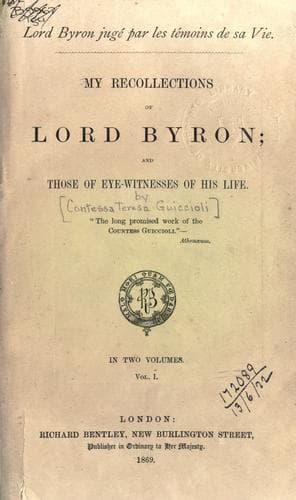
My Recollections of Lord ByronGuiccioli, Teresa, contessa di
General
My Recollections of Lord Byron
Guiccioli, Teresa, contessa di
Byron, George Gordon Byron, Baron, 1788-1824; Poets, English -- 19th century -- Biography
And Moore adds:--"The grave confidence with which the venerable critic
traces the fancies of his brother poet to real persons and events,
making no difficulty even of a double murder at Florence, to furnish
grounds for his theory, affords an amusing instance of the disposition,
so prevalent throughout Europe, to picture Byron as a man full of
marvels and mysteries, as well in his life as his poetry. To these
exaggerated or wholly false notions of him, the numerous fictions palmed
upon the world, of his romantic tours and wonderful adventures in places
he never saw, and with persons who never existed, have, no doubt,
considerably contributed, and the consequence is, so utterly out of
truth and nature are the representations of his life and character long
current upon the Continent, that it may be questioned whether the real
'flesh and blood' hero of these pages (the social, practical-minded,
and, with all his faults and eccentricities, English Lord Byron) may
not, to the over-exalted imaginations of most of his foreign admirers,
appear only an ordinary, unromantic, and prosaic personage."
Then, quoting some of the falsehoods which were spread everywhere about
Byron, Moore says:--
"Of this kind are the accounts, filled with all sorts of circumstantial
wonders, of his residence in the island of Mytilene; his voyages to
Sicily, to Ithaca, with the Countess Guiccioli, etc. But the most
absurd, perhaps, of all these fabrications are the stories told by
Pouqueville, of the poet's religious conferences in the cell of Father
Paul, at Athens; and the still more unconscionable fiction in which Rizo
has indulged, in giving the details of a pretended theatrical scene, got
up (according to this poetical historian) between Lord Byron and the
Archbishop of Arta, at the tomb of Botzaris, at Missolonghi."
As the numerous causes which led to the false judgment of Byron's true
character never ceased to exist during his lifetime, one consequence has
been that those who never knew him have never been able to arrive at
the truth of matters concerning him. The contrast which existed between
the real and imaginary personage was such as to cause the greatest
astonishment to all those who, having hitherto adopted the received
notions about him, at last came to know him at Ravenna, at Pisa, at
Genoa, and in Greece, up to the very last days of his life. But, before
quoting some of these fortunate travellers, I must transcribe a few more
passages from Moore:
"On my rejoining him in town this spring, I found the enthusiasm about
his writings and himself, which I had left so prevalent, both in the
world of literature and society, grown, if any thing, still more genuine
and intense. In the immediate circle perhaps around him, familiarity of
intercourse must have begun to produce its usual disenchanting effect."
Public-domain text, read in full here on John Shaqi.
Reviews
Reviews
No reviews yet
Be the first to share your thoughts on this work.
Elsewhere in the archive
Join the Discussion
Join the discussion
Sign in to leave a comment or review.
Sign InorCreate an account