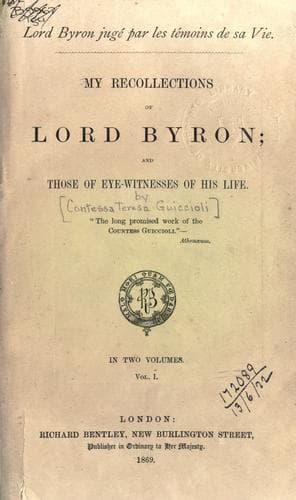
My Recollections of Lord ByronGuiccioli, Teresa, contessa di
General
My Recollections of Lord Byron
Guiccioli, Teresa, contessa di
Byron, George Gordon Byron, Baron, 1788-1824; Poets, English -- 19th century -- Biography
"Inclosed is something which will interest you, to wit, the opinion of
the greatest man of Germany, perhaps of Europe, upon one of the great
men of your advertisements (all 'famous hands,' as Jacob Tonson used to
say of his ragamuffins)--in short, a critique of Goethe's upon
'Manfred.' There is the original, an English translation, and an Italian
one; keep them all in your archives, for the opinions of such a man as
Goethe, whether favorable or not, are always interesting; and this more
so, as being favorable. His 'Faust' I never read, for I don't know
German; but Matthew Monk Lewis, in 1816, at Geneva, translated most of
it to me _viva voce_, and I was naturally much struck with it: but it
was the 'Steinbach,' and the 'Yungfrau,' and something else, much more
than 'Faustus,' that made me write 'Manfred.' The first scene, however,
and that of 'Faustus' are very similar."
One can scarcely conceive how so great a mind as that of Goethe could
have been duped by such mystifications. And yet this is what he wrote at
that time in a German paper relative to Byron's "Manfred:"--
"We find in this tragedy the quintessence of the most astonishing talent
borne to be its own tormentor. The character of Lord Byron's life and
poetry hardly permits a just and equitable appreciation. He has often
enough confessed what it is that torments him. He has repeatedly
portrayed it, and scarcely any one feels compassion for this intolerable
suffering over which he is ever laboriously ruminating. There are,
properly speaking, two females whose phantoms forever haunt him, and
which, in this piece also, perform principal parts, one under the name
of Astarte, the other without form or actual presence, and merely a
voice. Of the horrid occurrence which took place with the former the
following is related. When a bold and enterprising young man, he won the
affections of a Florentine lady. Her husband discovered the amour, and
murdered his wife; but the murderer was the same night found dead in
the street, and there was no one to whom any suspicion could be
attached. Lord Byron removed from Florence, and these spirits haunted
him all his life after.
"This romantic incident is rendered highly probable by innumerable
allusions to it in his poems."
Public-domain text, read in full here on John Shaqi.
Reviews
Reviews
No reviews yet
Be the first to share your thoughts on this work.
Elsewhere in the archive
Join the Discussion
Join the discussion
Sign in to leave a comment or review.
Sign InorCreate an account