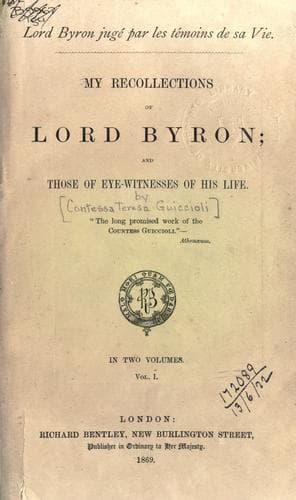
My Recollections of Lord ByronGuiccioli, Teresa, contessa di
General
My Recollections of Lord Byron
Guiccioli, Teresa, contessa di
Byron, George Gordon Byron, Baron, 1788-1824; Poets, English -- 19th century -- Biography
I have mentioned elsewhere how Moore, while justly appreciating the
consequences of this youthful eccentricity,--of which later, but too
late, Byron corrected himself,--does not equally appreciate the motives,
or rather the principal motive, which gave rise to it. As, however, he
judges rightly of the results, I shall continue to quote him for the
reader's benefit.
"M. Galignani, having expressed a wish to be furnished with a short
memoir of Lord Byron for the purpose of prefixing it to the French
edition of his works, I had said jestingly, in a preceding letter to his
lordship, that it would but be a fair satire on the disposition of the
world to 'remonster his features' if he would write for the public,
English as well as French, a sort of mock heroic account of himself,
outdoing in horrors and wonders all that had been yet related or
believed of him, and leaving even Goethe's story of the double murder at
Florence far behind."
Lord Byron replied from Pisa, on the 12th of December, 1821:--"What you
say about Galignani's two biographies is very amusing; and, if I were
not lazy, I would certainly do what you desire. But I doubt my present
stock of facetiousness--that is, of good serious humor--so as not to let
the cat out of the bag. I wish you would undertake it. I will forgive
and _indulge_ you (like a pope) beforehand, for any thing ludicrous that
might keep those fools in their own dear belief that a man is a
_loup-garou_.
"I suppose I told you that the 'Giaour' story had actually some
foundation in fact.... I should not like marvels to rest upon any
account of my own, and shall say nothing about it.... The worst of any
real adventures is that they involve living people."
He at last tired of always appearing in the guise of a corsair, or of a
mysterious criminal, or of a hero of melodrama. These various disguises
had afforded him too much pain, and one day he said to Mr. Medwin:--
"When Galignani thought of publishing a fresh edition of my works he
wrote to Moore to ask him to give him some anecdotes respecting me: and
we thought of composing a narrative filled with the most impossible and
incredible adventures, to amuse the Parisians. But I reflected that
there were already too many ready-made stories about me, to puzzle my
brain to invent new ones."
Mr. Medwin adds:--
"The reader will laugh when he hears that one of my friends assured me
that the lines of Thyrza, published with the first canto to 'Childe
Harold,' were addressed by Byron to his bear! There is nothing too
wicked to be invented by hatred, or believed by ignorance."
Moore often refers to the wonderful contrast which existed between the
real and imaginary Byron. Thus, in speaking of his incredibly active and
sublime genius at Venice, he says:--
Public-domain text, read in full here on John Shaqi.
Reviews
Reviews
No reviews yet
Be the first to share your thoughts on this work.
Elsewhere in the archive
Join the Discussion
Join the discussion
Sign in to leave a comment or review.
Sign InorCreate an account