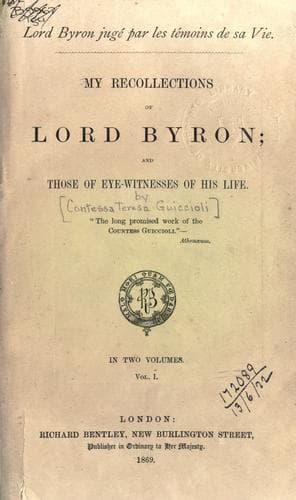
My Recollections of Lord ByronGuiccioli, Teresa, contessa di
General
My Recollections of Lord Byron
Guiccioli, Teresa, contessa di
Byron, George Gordon Byron, Baron, 1788-1824; Poets, English -- 19th century -- Biography
"While thus at this period, more remarkably than at any other during his
life, the unparalleled versatility of his genius was unfolding itself,
those quick, chameleon-like changes of which his character, too, was
capable, were, during the same time, most vividly and in strongest
contrast, drawn out. To the world, and more especially to England,--the
scene at once of his glories and his wrongs,--he presented himself in
no other aspect than that of a stern, haughty misanthrope, self-banished
from the fellowship of men, and most of all from that of Englishmen...."
How totally all this differed from the Byron of the social hour, they
who lived in familiar intercourse with him may be safely left to tell.
The reputation which he had acquired for himself abroad, prevented
numbers, of course, of his countrymen, whom he would most cordially have
welcomed, from seeking his acquaintance. But as it was, no "English
gentleman ever approached him, with the common forms of introduction,
that did not come away at once surprised and charmed by the kind
courtesy and facility of his manners, the unpretending play of his
conversation, and, on a nearer intercourse, the frank youthful spirits,
to the flow of which he gave way with such a zest as even to deceive
some of those who best knew him into the impression that gayety was,
after all, the true bent of his disposition."
I must confine myself to these quotations, as it is not in my power to
reproduce all that Moore has said on the subject. His statements,
however, prove two things:--
First, that Lord Byron, instead of being a dark and gloomy hero of
romance, was a man full of amiability, goodness, grace, sociability, and
liveliness. Of the impression produced upon all those who knew him in
these combined qualities, I shall have occasion to speak hereafter.
Secondly, that since even after Byron's death the fantastical notions
about him were entertained even by so impartial and so enlightened a
person as Sir Edward Brydges, it is not surprising (nor should they be
blamed for it) that Frenchmen, and all foreigners in general, and even a
great portion of Englishmen, should have believed in this fallacy. There
was no means at that time of clearing up the mystery, nor can one see in
this belief, however exaggerated, especially in France and on the
Continent, any spirit either of direct hostility, or even ill-will
toward him. The error was exported from England, and upon it they
reasoned, logically and oftentimes wittily. But surely those can not be
absolved who still adhere to the old errors, after the true state of
things had been disclosed at the poet's death in the writings of such
biographers as Moore, Parry, Medwin himself, Count Gamba, and others
who knew Byron personally.
Public-domain text, read in full here on John Shaqi.
Reviews
Reviews
No reviews yet
Be the first to share your thoughts on this work.
Elsewhere in the archive
Join the Discussion
Join the discussion
Sign in to leave a comment or review.
Sign InorCreate an account