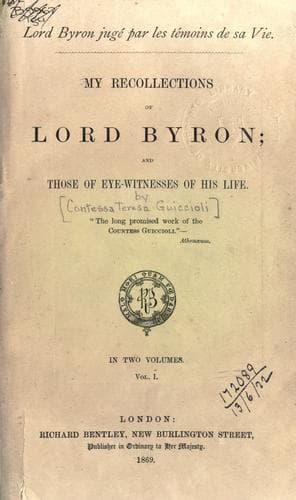
My Recollections of Lord ByronGuiccioli, Teresa, contessa di
General
My Recollections of Lord Byron
Guiccioli, Teresa, contessa di
Byron, George Gordon Byron, Baron, 1788-1824; Poets, English -- 19th century -- Biography
The glory of nations, great souls, great minds, their works, their
deeds, all must serve to complement his victory. Bossuet, Newton, Dante,
Shakspeare, Corneille, Byron, all have erred. If he despises them, if he
blames them, it is only to show that they have not been able to discover
the logical conclusions which M. Taine at last reveals to
us,--conclusions which are to transform and change the soul as well as
the understanding. This doctrine has hitherto been but a dream, and
society has, up to the present time, walked in darkness.
This philosophical system is so beautifully set forth, that it can only
be compared to a skeleton, upon which a profusion of lovely-scented
flowers and precious jewels have been heaped, so that, notwithstanding
the horror it inspires, one is unable to leave it.
Here, then, we find that M. Taine comes forth resolutely, by the help of
a vigorous understanding and a surpassing talent, to review all that
England has produced in a literary sense,--authors as well as their
works. The type which he has conceived alone escapes his censure. This
type must be the result of three primeval causes, viz., race, centre and
time. History must prove its correctness. History and logic might in
vain claim his indulgence on behalf of other types. He has conceived his
system in his own mind, and, to establish it, facts and characters are
made subservient to it; history's duty is to prove their correctness.
Indulgence can be shown to one type only.
All he says is, however, so well said, that if he offended truth a
little less, if he only spoke for beings in another planet, and above
all, if, under these beautiful surroundings, one failed to notice the
gloom of a heaven without God, the work would enchant one.
It must be allowed that the charms of truth are still to be preferred;
we must therefore be allowed to say a few words about M. Taine's system.
It can only be in one sense; not on account of any philosophical
pretension, nor in the hope of restoring nature to its rights, however
much we may grieve at seeing it reduced to a mere animal, nay, a
vegetable, and alas! may be, a mineral system.
Many able pens will repeat the admirable words of one of the cleverest
men of the day, who, in his criticism upon M. Taine's book, has so
thoroughly examined how far a physiological method could be applied to
the comprehension of moral and intellectual phenomena, and has shown to
what fatal consequences such a method must lead. The analysis of the
moral world, the study of souls and of talent, of doctrines and of
characters, become in M. Taine's mind only a branch of zoology, and
psychology ends by being only a part of natural history.
Many other able writers will echo the noble words of M. Caro, and will
not fail to point out the numerous contradictions which exist between
the work itself and history proper, between it and natural history, and,
finally, between it and the author himself.
Public-domain text, read in full here on John Shaqi.
Reviews
Reviews
No reviews yet
Be the first to share your thoughts on this work.
Elsewhere in the archive
Join the Discussion
Join the discussion
Sign in to leave a comment or review.
Sign InorCreate an account