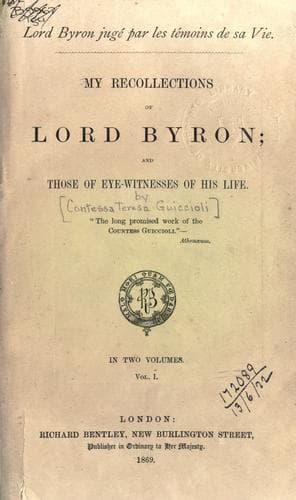
My Recollections of Lord ByronGuiccioli, Teresa, contessa di
General
My Recollections of Lord Byron
Guiccioli, Teresa, contessa di
Byron, George Gordon Byron, Baron, 1788-1824; Poets, English -- 19th century -- Biography
That a portion of the British public should maintain certain prejudices,
and preserve a certain animosity against Byron, is not matter of
astonishment to those who have at all studied the English character. The
spirit of tolerance which exists in the laws, is far from pervading the
habits of the people; cant is on the decrease, but not quite gone, and
may still lead one to a very fair social position. There still live a
host of enemies whom Byron had made during his lifetime, and the number
of whom (owing to a bona fide treachery, by the indiscreet publication
of a correspondence which was destined to be kept secret and in the
dark), increased greatly after his death from the number of people whose
pride he had therein wounded.
He may be liable to the punishment due to his having trespassed on
certain exclusively English notions of virtue, as intimated in the
condemnation of the _imaginary_ immorality of some of his works. He may
be accused, with some truth, of having been too severe toward several
persons and things. But not one of these reasons has any _locus standi_
in France,--a country which might claim a certain share in the honor of
having been his mother-country. Besides having a French turn of mind in
many respects, Byron, descended directly from a French stock, had been
conceived in France, and had long lived in its neighborhood. If those,
therefore, may be absolved who falsely appreciated Byron's character
both before and immediately after his death, the same indulgence can not
be extended to those who persist in their unjust conclusions. Such men
were greatly to blame; for, in writing about Byron, they were bound in
conscience to consult the biographers who had known him, and having
neglected to do so, either from idleness or from party spirit, they
failed in their duty as just and honorable men.
Before finishing this chapter, we must add to these pages, which were
written many years ago, a few remarks suggested by the perusal of a
recent work which has caused great sensation by the talent which
pervades it, by its boldness, and original writing. I allude to the work
of M. Taine upon English literature; therein he appreciates, in a manly,
fine style, all the loftiness of Lord Byron's poetry, but always under
the influence of a received, and not self-formed, opinion. He likewise
deserves, by his appreciations and conclusions, the reproaches addressed
to the other critics of the illustrious and calumniated poet. In this
work, which is rather magnificent than solid, and which contains a whole
psychological system, one note is ever uppermost,--that of disdain.
Contempt, however, is not his object, but only his means. All must be
sacrificed to the triumph of his opinions.
Public-domain text, read in full here on John Shaqi.
Reviews
Reviews
No reviews yet
Be the first to share your thoughts on this work.
Elsewhere in the archive
Join the Discussion
Join the discussion
Sign in to leave a comment or review.
Sign InorCreate an account