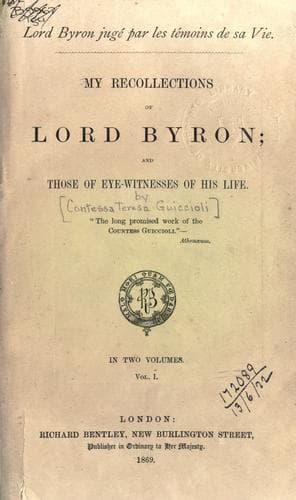
My Recollections of Lord ByronGuiccioli, Teresa, contessa di
General
My Recollections of Lord Byron
Guiccioli, Teresa, contessa di
Byron, George Gordon Byron, Baron, 1788-1824; Poets, English -- 19th century -- Biography
"I wrote a sort of mad drama for the sake of introducing the Alpine
scenery. Almost all the _dramatis personae_ are spirits, ghosts, or
magicians; and the scene is in the Alps and the other world, so you may
suppose what a Bedlam tragedy it must be.... The third act, like the
Archbishop of Grenada's homily (which savored of the palsy), has the
dregs of my fever, during which it was written. It must on no account be
published in its present state.... The speech of Manfred to the sun is
the only part of this act I thought good myself; the rest is certainly
as bad as bad can be, and I wonder what the devil possessed me."
But let Byron's ideas take a different turn, as the lovely blue Italian
sky and the refreshing breezes from the Adriatic waters contribute to
quicken his blood, and other tones will be heard, wherein no longer
shall the excesses, but the beauties only of energy be discernible.
What does M. Taine say then? This new aspect does not, evidently,
satisfy him! but what of that? He goes on to say that Byron's genius is
falling off. If the poet takes advantage of a few moments of melancholy
common to all poetical and feeling souls, M. Taine declares that the
melancholy English nature is always associated with the epicurean. What
is it to him, that England thinks differently? that in her opinion Lord
Byron's grandest and noblest conceptions are the poems which he wrote in
Italy, and even on the eve of his death? and that she finds his
liveliness "too real and too ultramontane to suit her national tastes?"
Nothing of this troubles M. Taine.
Is it quite fair to judge so powerful a mind, so great and yet so simple
a being as Lord Byron, only by his "Manfred," or by some other passages
of his works, and especially of "Don Juan?" Can his amiable, docile,
tender, and feeling nature honestly be seen in the child of three years
of age, who tears his clothes because his nurse has punished him
unfairly? No; all that we see is what M. Taine wishes us to see for the
purpose he has in view, that is, admiration of the Lord Byron he has
conceived, and who is necessary to his cause,--a Byron only to be
likened to a furious storm.
Public-domain text, read in full here on John Shaqi.
Reviews
Reviews
No reviews yet
Be the first to share your thoughts on this work.
Elsewhere in the archive
Join the Discussion
Join the discussion
Sign in to leave a comment or review.
Sign InorCreate an account