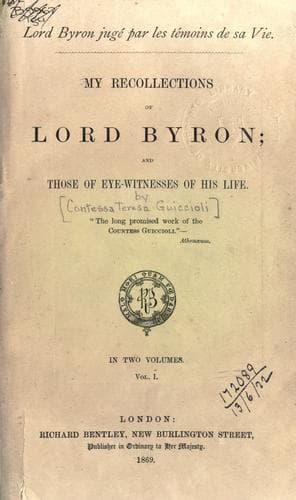
My Recollections of Lord ByronGuiccioli, Teresa, contessa di
General
My Recollections of Lord Byron
Guiccioli, Teresa, contessa di
Byron, George Gordon Byron, Baron, 1788-1824; Poets, English -- 19th century -- Biography
Wishing Byron to appear as the type of energy, M. Taine exhibits him to
our eyes in the light of Satan defying all powers on earth and in
heaven. The better to mould him to the form he has chosen, he begins by
disfiguring him in the arms of his mother, whom with his father and his
family he scruples not to calumniate. Storms having their origin in the
rupture of the elements, and a violent character being, according to M.
Taine, the result of several forces acting internally and mechanically;
it follows that its primary cause is to be found in the disturbed moral
condition of those who have given birth to him in the circumstances
under which the child was born, and in the influence under which he has
been brought up. Hence the necessity of supplementing from imagination
the historical and logical facts which otherwise might be at fault.
As for Lord Byron's softness of manner, and as to that tenderness of
character which was the bane of his existence,--as to his real and great
goodness, which made him loved always and everywhere, and which caused
such bitter tears to be shed at the news of his death,--these qualities
are not to be sought in the strange, fanciful being who is styled Byron
by M. Taine. These qualities would be out of place; they would be
opposed to the idea upon which his entire system is founded. They must
be merged in the energy and greatness of intellect of the poetical
giant.
Unfortunately for M. Taine, facts speak too forcibly and too
inopportunely against him. Not one of the causes which he mentions, not
one of the conclusions which he draws in respect to Lord Byron's
character as a poet, and as a mere mortal, are to be relied upon. He,
who contends that he possesses pre-eminently the power of comprehending
the man and the author, insists that Lord Byron was no exception to the
rule, though his best biographer, Moore, most distinctly opposes this
opinion:--
"In Lord Byron, however, this sort of pivot of character was almost
wholly wanting.... So various indeed, and contradictory, were his
attributes, both moral and intellectual, that he may be pronounced to
have been not one, but many; nor would it be any great exaggeration of
the truth to say that out of the mere partition of the properties of his
single mind a plurality of characters, all different and all vigorous,
might have been furnished."
Public-domain text, read in full here on John Shaqi.
Reviews
Reviews
No reviews yet
Be the first to share your thoughts on this work.
Elsewhere in the archive
Join the Discussion
Join the discussion
Sign in to leave a comment or review.
Sign InorCreate an account