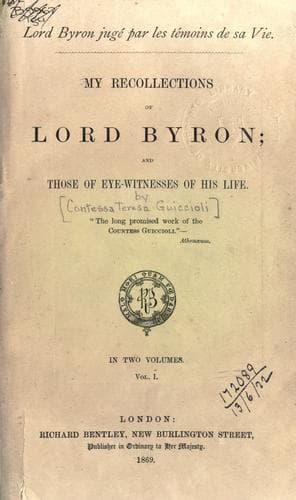
My Recollections of Lord ByronGuiccioli, Teresa, contessa di
General
My Recollections of Lord Byron
Guiccioli, Teresa, contessa di
Byron, George Gordon Byron, Baron, 1788-1824; Poets, English -- 19th century -- Biography
His intellectual inquisitiveness was likewise, with him, a precocious
passion, and circumstances stood so well in the way to serve this
craving, that when fifteen years of age (incredible as it seems), he had
already perused two thousand volumes, among which his powerful and vivid
intellect had been able to weigh the contradictions of all the principal
modern and ancient systems of philosophy. This thirst for knowledge
(anomalous according to the rules of both school and college) was the
more extraordinary that it existed in him together with a passionate
love for boyish play, and the indulgence in all the bodily exercises, in
which he excelled, and on which he prided himself. But as he stored his
mind after the usual college hours, and apart from the influences of
that routine discipline, which, with Milton, Pope, and almost all the
great minds, he so cordially hated, the real progress of his intellect
remained unobserved by his masters, and even by his fellow-students.
This mistake, on the part of men little gifted with quickness of
perception, was not shared by Disraeli, who could so justly appreciate
genius; and of Byron he spoke as of a studious boy, who loved to hide
this quality from his comrades, thinking it more amiable on his part to
appear idle in their eyes.
While the young man thus strengthened his intellect by hard though
irregular study, his meditative and impassioned nature, feeling in the
highest degree the necessity of confirming its impressions, experienced
more imperatively than a youth of fifteen generally does, the want of
examining the traditional teachings which had been transmitted to him.
Byron felt the necessity of inquiring on what irrevocable proofs the
dogmas which he was called upon to believe were based. Holy writ, aided
by the infallibility of the teachings of the Church, etc., were adduced
as the proofs he required.
He was wont, therefore, to read with avidity a number of books treating
on religious matters; and he perused them, both with artless ingenuity
and in the hope of their strengthening his faith. But, could he truly
find faith in their pages? Are not such books rather dangerous than
otherwise for some minds?
Public-domain text, read in full here on John Shaqi.
Reviews
Reviews
No reviews yet
Be the first to share your thoughts on this work.
Elsewhere in the archive
Join the Discussion
Join the discussion
Sign in to leave a comment or review.
Sign InorCreate an account