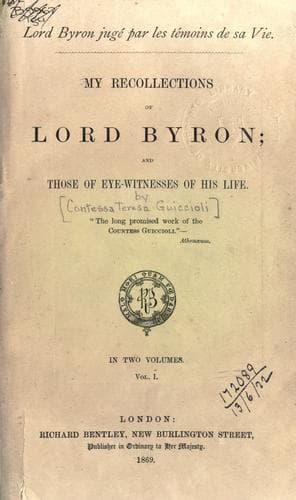
My Recollections of Lord ByronGuiccioli, Teresa, contessa di
General
My Recollections of Lord Byron
Guiccioli, Teresa, contessa di
Byron, George Gordon Byron, Baron, 1788-1824; Poets, English -- 19th century -- Biography
"The truth is," says the author of the "Essays," "that a mind which has
never entertained a doubt in revelation, may conceive some doubts by
reading books written in its defense." And he adds elsewhere, in
speaking of the writers of such controversial works, that "impatient of
the least hesitation, they deny with anger the value of their
adversary's arguments, and betray, in their way of getting over
difficulties, a humor which injures the effects of their reasoning, and
of the proofs they make use of to help their arguments." After reading
several of these books, he must have found, as did the great Pitt, "that
such readings provoke many more doubts than they dispel;" and, in fact,
they rather disquieted and shook, than strengthened his faith. At the
same time, he was alive to another striking contradiction. He noticed
that the men who taught the doctrines, too often forgot to make these
and their practice agree; and in losing his respect for his masters, he
still further doubted the sincerity of their teaching. Thus, while
remaining religiously inclined, he must have felt his faith becoming
more and more shaken, and in the memorandum of his early days, after
enumerating the books treating upon religious subjects which he had
read, he says: "All very tedious. I hate books treating of religious
subjects; although I adore and love God, freed from all absurd and
blasphemous notions."
In this state of mind, of which one especially finds a proof in his
earlier poems, the philosophy of Locke, which is that professed at
Cambridge, and which he had already skimmed, as it were, together with
other philosophical systems, became his study. It only added an enormous
weight in the way of contradictions to the already heavy weight of
doubt.
Could it be otherwise? Does not Locke teach that all ideas being the
creation of the senses, the notion of God, unless aided by tradition,
has no other basis but our senses and the sight of the external world?
If this be not the doctrine professed by Locke, it is the reading which
a logical mind may give to it.
He believes in God; yet the notion of God, as it appears from his
philosophical teaching, is not that which is taught by Christian
doctrine. According to him, God is not even proclaimed to be the Creator
of the Universe. But even were He proclaimed such, what would be the
result of this philosophical condescension, unless it be that God is
distinct from the world? Would God possess then all those attributes
which reason, independently of all philosophy, points to in the
Divinity? Would power, goodness, infinite perfection be God's? Certainly
not: as we are unable to know Him except through a world of
imperfections, where good and evil, order and confusion, are mixed
together, and not by the conception of the infinite, which alone can
give us a true and perfect idea of God, it follows that God would be
much superior to the world, but would not be absolute perfection.
Public-domain text, read in full here on John Shaqi.
Reviews
Reviews
No reviews yet
Be the first to share your thoughts on this work.
Elsewhere in the archive
Join the Discussion
Join the discussion
Sign in to leave a comment or review.
Sign InorCreate an account