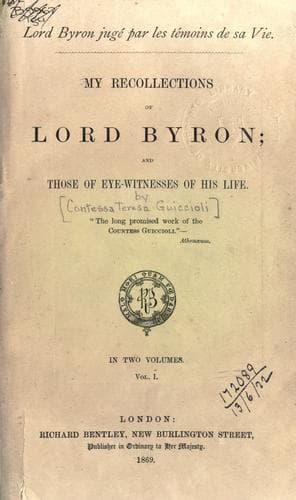
My Recollections of Lord ByronGuiccioli, Teresa, contessa di
General
My Recollections of Lord Byron
Guiccioli, Teresa, contessa di
Byron, George Gordon Byron, Baron, 1788-1824; Poets, English -- 19th century -- Biography
After this depreciation of the Omnipotent, what says this philosophy of
our soul? It does away altogether with one of the essential proofs of
its spiritual nature, and thereby compromises the soul itself, declaring
as it does, that "it is not unlikely that matter is capable of thought."
But then of what necessity would the soul be, if the body can think? How
hope for immortality, if that which thinks is subject to dissolution and
to death?
As for our liberty, it would be annihilated as a consequence of such
doctrines; for it is not supposed to derive its essence from the
interior activity of the soul, but would seem to be limited to our power
of moving. Yet we are hourly experiencing what our weakness is in
comparison with the power of the laws of nature, which rule us in every
sense and way. In making, therefore, all things derivable from
sensations, Locke fell from one error into another, and nearly arrived
at that point when duty and all principles of justice and morality might
be altogether denied. Being himself, however, both good, honest,
liberal, and Christian-minded, he could only save himself from the
social wreck to which he exposed others, by stopping on the brink of the
abyss which he had himself created, and by becoming in practice
inconsistent with his speculative notions. His successors, such as
Condillac and Cabanis, fell by following his system and by carrying it
too far.
A doctrine which denies the right of discovering, or of explaining the
religious truths which are the grounds of all moral teaching, and which
allows tradition the privilege only of bestowing faith; a system of
metaphysics, which can not avoid the dangers in which morality must
perish, owing to its contradictions and its inconsistencies, must be
perilous for all but those happily constituted minds for whom simple
faith and submission are a part of their essence, who believe on hearsay
and seek not to understand, but merely glance at the surface of the
difficult and venturesome questions which are discussed before them,
either because they feel their weakness, or because the light of
revelation shines upon them so strongly as to make that of reason pale.
For more logical minds, however, for such who are inquisitive, whose
reason is both anxious and exacting, who want to understand before they
believe, for whom the ties which linked them to tradition have been
loosened, owing to their having reflected on a number of contradictions
(the least of which, in the case of Lord Byron, was decidedly not that
of seeing such a philosophy professed and adopted in a clerical
university); for minds like these such doctrines must necessarily lead
to atheism. Though Lord Byron's mind was one of these, he escaped the
fearful results by a still greater effort of his reason, which made him
reject the precepts of the sensualists, and comprehend their
inconsistencies.
Public-domain text, read in full here on John Shaqi.
Reviews
Reviews
No reviews yet
Be the first to share your thoughts on this work.
Elsewhere in the archive
Join the Discussion
Join the discussion
Sign in to leave a comment or review.
Sign InorCreate an account