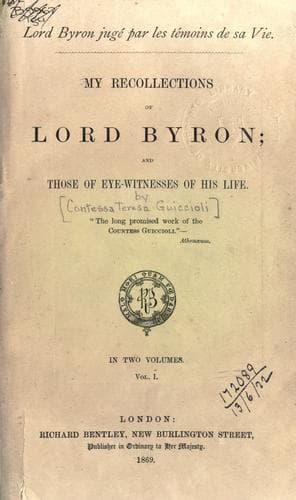
My Recollections of Lord ByronGuiccioli, Teresa, contessa di
General
My Recollections of Lord Byron
Guiccioli, Teresa, contessa di
Byron, George Gordon Byron, Baron, 1788-1824; Poets, English -- 19th century -- Biography
While his mind thus wavered between a thousand contradictory opinions,
and, finding part of the truth only in every philosophical system which
he examined, but not the whole truth--which was what his soul thirsted
for; calling himself at times skeptic, because he hesitated in adhering
to one school, in consequence of the numerous errors and inconsistencies
common to all (the great school which has, to the honor of France,
harmonized them all, was not yet open); but not losing sight of the
great eternal truths of which he felt inwardly the proofs, he made the
acquaintance of a young man who had just completed his university
education with great success. This young man, who exercised a great
influence over all his fellow-students, owing to his superior intellect,
influenced Byron in a similar manner. Bold, logical, inflexible, he was
not swayed by the dangers which the sensualistic teaching presented to
all logical minds; dangers which had frightened the chief of that school
himself, and who, in wishing to oppose them, had not been able to do so
except by contradictions. This young man, by a noble inconsistency, drew
back in presence of the moral conclusions of that metaphysical doctrine,
but not without culling from the master's thoughts conclusions, such
that they leave all that is spiritual and immortal without defense,
together with all the legitimate inferences to be derived from the
principles he taught, however impious or absurd.
Among the Germans he had likewise met with several bold doctrines; but,
merely to speak here of the conclusions to which the school he belonged
necessarily brought him, he arrived at those conclusions by a series of
deductions from the study of those great questions, which experience
always ends by referring either to reason or to revelation. Compelled by
the tenets of that school, to solve all these problems by means of the
sensations only, he was naturally led to the conclusion that no such
thing existed as the spirituality of the soul, and hence, that it had
neither the gift of immortality nor that of liberty, nor any principles
of morality. Finally, obliged to seek in tradition the conviction that a
God existed, and that He can only be perceived through a maze of
imperfections, and not as reason conceives Him clearly and simply with
all His necessary attributes of perfection, he was even led to the
necessity of losing sight of a Creator altogether.
Public-domain text, read in full here on John Shaqi.
Reviews
Reviews
No reviews yet
Be the first to share your thoughts on this work.
Elsewhere in the archive
Join the Discussion
Join the discussion
Sign in to leave a comment or review.
Sign InorCreate an account