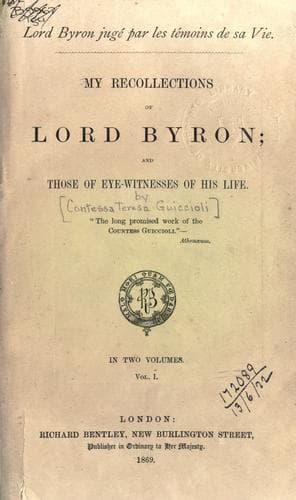
My Recollections of Lord ByronGuiccioli, Teresa, contessa di
General
My Recollections of Lord Byron
Guiccioli, Teresa, contessa di
Byron, George Gordon Byron, Baron, 1788-1824; Poets, English -- 19th century -- Biography
The fatal precipice, which this young student himself avoided by the
practical conclusions by which he abided, Byron likewise escaped both by
his conclusions and his theoretical notions. He even hated the name of
atheist to that degree, that at Harrow he wished to fight his companion
Lord Althorpe, because he had written the word atheist under Byron's
name. This is so true that Sir Robert Dallas, of whose judgment no
interpretation can ever be given without making allowances for the
intolerant spirit and the exaggeration required by his notions of
orthodoxy and by his party prejudices, after regretting that Lord Byron
should not have had a shield during his minority to protect him against
his comrades, "proud, free-thinking, and acute sophists," as he calls
them, adds that, if surprise must be expressed, it is not that Byron
should have erred, but that he should have pierced the clouds which
surrounded him, and have dispersed them by the sole rays of his genius.
So many struggles, however, so many contradictions, so many strains upon
the mind, while leaving his heart untouched, could not but multiply the
doubts which he conceived, and more or less modify his mind, and even
give to it a tinge of skepticism.
When he left England for the first time, his mind was in this
transitory, suffering state. The various countries which he visited, the
various creeds with which he became acquainted the intolerance of the
one, the laxity in others in direct opposition to their superstitious
and irrational practices; the truly touching piety which he found in the
Greek monasteries (at Zytza and at Athens), in the midst of which and in
the silence of whose cloisters, he loved to share the peace and even the
austerities of a monkish life; his transition from the Western
countries, where reason is placed above imagination, to the East, where
the opposite is aimed at--all contributed to prevent what was
vacillating in his mind from becoming settled. Meanwhile endless
disappointments, bitter sorrows, and broken illusions contributed their
share to the pain which his mind experienced at every stage of its
philosophical inquiry, and contributed to give him, in the loneliness of
his life, a tinge of misanthropy opposed to his natural character, which
suggested the rather philosophical and generous than prudent conception
of "Childe Harold's Pilgrimage," where he depicts his hero as
intellectually imbued with philosophical doctrines which lead practical
minds to skepticism and materialism! These doctrines resulted in causing
"Childe Harold" to lose that traditional faith which gives peace to the
soul by insuring conviction to the mind. The poet shows the
impossibility of withdrawing himself from their disastrous results when
arrived at the age when passions assert their rule, and when in a
certain social position, they must be carried into practice. Nature not
having gifted him with a sufficiently generous heart to check the
Public-domain text, read in full here on John Shaqi.
Reviews
Reviews
No reviews yet
Be the first to share your thoughts on this work.
Elsewhere in the archive
Join the Discussion
Join the discussion
Sign in to leave a comment or review.
Sign InorCreate an account