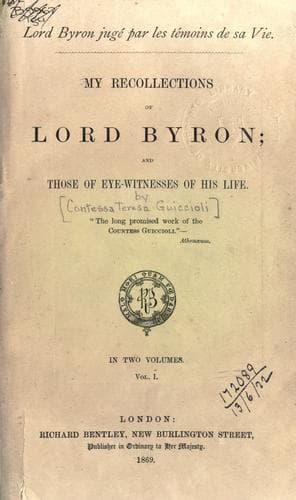
My Recollections of Lord ByronGuiccioli, Teresa, contessa di
General
My Recollections of Lord Byron
Guiccioli, Teresa, contessa di
Byron, George Gordon Byron, Baron, 1788-1824; Poets, English -- 19th century -- Biography
He therefore laughed at these accusations as too absurd. As for
skepticism, he did not defend himself from a touch of it; for not only
did he feel that the suspicious stanza could partly justify the belief,
but also because there did exist in him a kind of religious skepticism
which proceeded far more from meditation and observation than from a
passion for it. Such a skepticism is in truth a sigh for conviction. A
painful vision which appears to most reflective minds in a more or less
indistinct and vague manner, but which appeared more forcibly to him,
inasmuch as it sought to be expressed in words.
"He," says Montaigne, "who analyzes all the circumstances which have
brought about matters, and all the consequences which have been derived
from them, debars himself from having any choice, and remains
skeptical."
This skepticism of Lord Byron, however, did not overstep the boundaries
of permissible doubt, as prescribed by an intelligence desirous of
improvement. This privilege he exercised; and one might say that he
remained, as it were, suspended between heaven and earth, ever looking
up toward heaven, from whence he felt that light must come in the
end,--a light ever on the increase, which would daily steady him in the
great principles which form the fundamental basis of truth,--one God the
creator, the real immortality of our soul, our liberty and our
responsibility before God.
Tired, however, of ever being the butt of the invectives of his enemies,
and of the clergy, whom he had roughly handled in his writings, Lord
Byron preferred remaining silent; and until his arrival in Switzerland
he ceased making any allusions in his writings to any philosophical
doubts which he may have entertained. The heroes which he selected for
his Oriental poems were, moreover, too passionate to allow the
mysterious voices from heaven to silence the cries from their heart.
These celestial warnings, however, Byron never ceased to hear, although
absorbed himself by various passions of a different kind; he was at that
time almost surrounded by an idolizing public, and rocked in the cradle
of success and popularity. This is but too visible whenever he ceases to
talk the language of his heroes, and expresses merely his own ideas and
his own personal feelings. It was at this time that he wrote those
delicious "Hebrew Melodies," in which a belief in spirituality and
immortality is everywhere manifest, and in which is to be found the
moral indication, if not the metaphysical proof, of the working of his
mind in a religious point of view, as he matured in years. Two of these
Melodies especially, the third and the fifteenth, contain so positive a
profession of faith in the spiritualist doctrines, and carry with them
the mark of so elevated a Christian sentiment, that I can not forbear
quoting them _in extenso_.
IF THAT HIGH WORLD.
I.
Public-domain text, read in full here on John Shaqi.
Reviews
Reviews
No reviews yet
Be the first to share your thoughts on this work.
Elsewhere in the archive
Join the Discussion
Join the discussion
Sign in to leave a comment or review.
Sign InorCreate an account