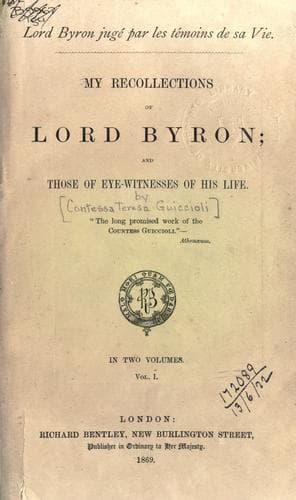
My Recollections of Lord ByronGuiccioli, Teresa, contessa di
General
My Recollections of Lord Byron
Guiccioli, Teresa, contessa di
Byron, George Gordon Byron, Baron, 1788-1824; Poets, English -- 19th century -- Biography
"I will do as you advise in regard to religious matters. The best would
perhaps be to avoid them altogether. Certainly the passages already
published are rather too rigorously interpreted. I am no bigot of
incredulity, and I did not expect that I should be accused of denying
the existence of God, because I had expressed some doubts as to the
immortality of the soul.... After all, I believe my doubts to be but
the effects of some mental illness."
It is clear from this letter, the tone of which is so honest and
sincere, that if in the stanzas which his rivals blamed there was really
more skepticism than can be gathered from the consideration of man's
littleness and God's greatness, yet it was not his real conviction.
Perhaps it was only a kind of cloud overhanging the mind, produced by
the great grief which weighed on his heart. These sentiments, however,
must have been really his own for some time longer. In his journal of
1813 he expresses himself thus:--
"My restlessness tells me I have something within that 'passeth show.'
It is for him who made it to prolong that spark of celestial fire which
illuminates yet burns this frail tenement.... In the mean time I am
grateful for some good, and tolerably patient under certain evils,
_grace a Dieu et a mon bon temperament_."
But all this, as we have said, amounted to the opinion that an
omnipotent God is the author of our soul, which is of a totally
different nature to that of our body, and that the soul being spiritual
and not subjected to the laws which rule the body, the soul must be
immortal. That he who made it out of nothing can cause it to return to
nothing. The orthodox doctrine does not teach, as pantheism does, that
our soul can not perish. It gives it only an individual immortality.
Notwithstanding this, and indeed on account of it, he was accused of
being an atheist, in a poem entitled "Anti-Byron." This poem was the
work of a clever rival, who made himself the echo of a party. Murray
hesitated to publish it, but Byron, who was always just, praised the
poem, and advised its publication.
"If the author thinks that I have written poetry with such tendencies,
he is quite right to contradict it."
But having done so much for others, this time, at least, he fulfilled a
duty toward himself by adding:--
"The author is however wrong on one point; I am not in the least an
atheist;" and ends by saying, "It is very odd; eight lines may have
produced eight thousand, if we calculate what has been and may still be
said on the subject."
He speaks of the same work to Moore, in the same tone of pleasantry:--
"Oh, by-the-by, I had nearly forgot. There is a long poem--an
'Anti-Byron'--coming out, to prove that I have formed a conspiracy to
overthrow by rhyme all religion and government, and have already made
great progress! It is not very scurrilous, but serious and ethereal. I
never felt myself important till I saw and heard of my being such a
little Voltaire as to induce such a production."
Public-domain text, read in full here on John Shaqi.
Reviews
Reviews
No reviews yet
Be the first to share your thoughts on this work.
Elsewhere in the archive
Join the Discussion
Join the discussion
Sign in to leave a comment or review.
Sign InorCreate an account