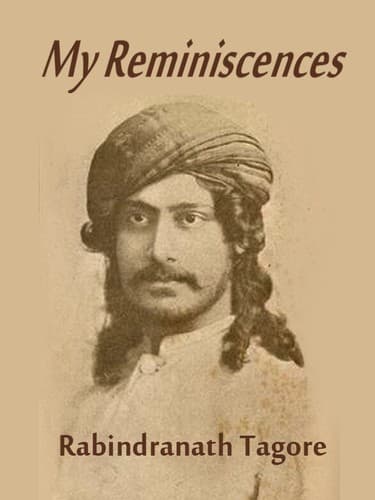
Authors, Bengali -- 20th century -- Biography; Tagore, Rabindranath, 1861-1941
[15] The Jupiter Pluvius of Hindu Mythology.
[16] The King of the Yakshas is the Pluto of Hindu Mythology.
[17] Corresponding to Lethe.
[18] Krishna's playground.
[19] Correspondence clerk.
[20] Spices wrapped in betel leaf.
[21] It is considered sinful for non-brahmins to cast glances on
neophytes during the process of their sacred-thread investiture, before
the ceremony is complete.
[22] Two novices in the hermitage of the sage Kanva, mentioned in the
Sanskrit drama, Sakuntala.
[23] The text for self-realisation.
[24] Bards or reciters.
[25] The Cow and the Brahmin are watchwords of modern Hindu Orthodoxy.
[26] An instrument on which the keynote is strummed to accompany
singing.
[27] A large proportion of words in the literary Bengali are derived
unchanged from the Sanskrit.
[28] Servants call the master and mistress father, and mother, and the
children brothers and sisters.
[29] Name of Vishnu in his aspect of slayer of the proud demon, Madhu.
[30] Nirada is a Sanscrit word meaning _cloud_, being a compound of
_nira_ = water and _da_ = giver. In Bengali it is pronounced _nirode_.
[31] Betel-leaf and spices.
[32] Father of the well-known artists Gaganendra and Abanindra. _Ed._
[33] In Bengali this word has come to mean an informal uninvited
gathering.
[34] Systems of notation were not then in use. One of the most popular
of the present-day systems was subsequently devised by the writer's
brother here mentioned. _Tr._
[35] The new bride of the house, wife of the writer's fourth brother,
above-mentioned. _Tr._
[36] It may be helpful to the foreign reader to explain that the expert
singer of Indian music improvises more or less on the tune outline made
over to him by the original composer, so that the latter need not
necessarily do more than give a correct idea of such outline. _Tr._
[37] This would mean "the genius of Bhubanmohini" if that be taken as
the author's name.
[38] Gifts of cloth for use as wearing apparel are customary by way of
ceremonial offerings of affection, respect or seasonable greeting.
[39] The old Vaishnava poets used to bring their name into the last
stanza of the poem, this serving as their signature. Bhanu and Rabi both
mean the Sun. _Tr._
[40] The dried and stripped centre-vein of a cocoanut leaf gives a long
tapering stick of the average thickness of a match stick, and a bundle
of these goes to make the common Bengal household broom which in the
hands of the housewife is popularly supposed to be useful in keeping the
whole household in order from husband downwards. Its effect on a bare
back is here alluded to.--_Tr._
[41] There was a craze for phrenology at the time. _Tr._
[42] Latterly Sir Tarak Palit, a life-long friend of the writer's second
brother. _Tr._
[43] Saraswati, the goddess of learning, is depicted in Bengal as clad
in white and seated among a mass of lotus flowers. _Tr._
Public-domain text, read in full here on John Shaqi.
Reviews
Reviews
No reviews yet
Be the first to share your thoughts on this work.
Elsewhere in the archive
Join the Discussion
Join the discussion
Sign in to leave a comment or review.
Sign InorCreate an account