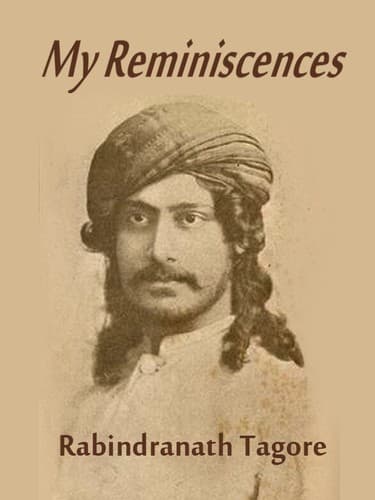
Authors, Bengali -- 20th century -- Biography; Tagore, Rabindranath, 1861-1941
I now sometimes wonder why such cruel treatment was meted out to us by
the servants. I cannot admit that there was on the whole anything in our
behaviour or demeanour to have put us beyond the pale of human kindness.
The real reason must have been that the whole of our burden was thrown
on the servants, and the whole burden is a thing difficult to bear even
for those who are nearest and dearest. If children are only allowed to
be children, to run and play about and satisfy their curiosity, it
becomes quite simple. Insoluble problems are only created if you try to
confine them inside, keep them still or hamper their play. Then does the
burden of the child, so lightly borne by its own childishness, fall
heavily on the guardian--like that of the horse in the fable which was
carried instead of being allowed to trot on its own legs: and though
money procured bearers even for such a burden it could not prevent them
taking it out of the unlucky beast at every step.
Of most of these tyrants of our childhood I remember only their cuffings
and boxings, and nothing more. Only one personality stands out in my
memory.
His name was Iswar. He had been a village schoolmaster before. He was a
prim, proper and sedately dignified personage. The Earth seemed too
earthy for him, with too little water to keep it sufficiently clean; so
that he had to be in a constant state of warfare with its chronic soiled
state. He would shoot his water-pot into the tank with a lightning
movement so as to get his supply from an uncontaminated depth. It was he
who, when bathing in the tank, would be continually thrusting away the
surface impurities till he took a sudden plunge expecting, as it were,
to catch the water unawares. When walking his right arm stood out at an
angle from his body, as if, so it seemed to us, he could not trust the
cleanliness even of his own garments. His whole bearing had the
appearance of an effort to keep clear of the imperfections which,
through unguarded avenues, find entrance into earth, water and air, and
into the ways of men. Unfathomable was the depth of his gravity. With
head slightly tilted he would mince his carefully selected words in a
deep voice. His literary diction would give food for merriment to our
elders behind his back, some of his high-flown phrases finding a
permanent place in our family repertoire of witticisms. But I doubt
whether the expressions he used would sound as remarkable to-day;
showing how the literary and spoken languages, which used to be as sky
from earth asunder, are now coming nearer each other.
Public-domain text, read in full here on John Shaqi.
Reviews
Reviews
No reviews yet
Be the first to share your thoughts on this work.
Join the Discussion
Join the discussion
Sign in to leave a comment or review.
Sign InorCreate an account