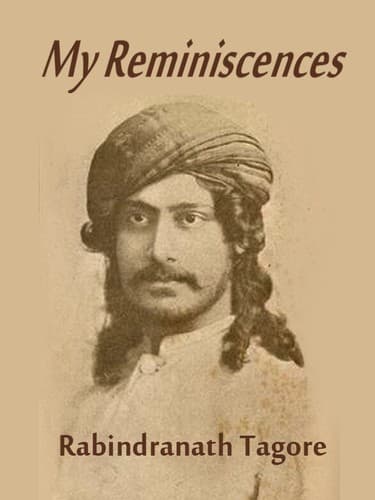
Authors, Bengali -- 20th century -- Biography; Tagore, Rabindranath, 1861-1941
My works had not as yet become voluminous. The poet could carry all his
effusions about in his pockets. I was writer, printer and publisher, all
in one; my brother, as advertiser, being my only colleague. I had
composed some verses on The Lotus which I recited to Nabagopal Babu then
and there, at the foot of the stairs, in a voice pitched as high as my
enthusiasm. "Well done!" said he with a smile. "But what is a
_dwirepha_?"[11]
How I had got hold of this word I do not remember. The ordinary name
would have fitted the metre quite as well. But this was the one word in
the whole poem on which I had pinned my hopes. It had doubtless duly
impressed our officers. But curiously enough Nabagopal Babu did not
succumb to it--on the contrary he smiled! He could not be an
understanding man, I felt sure. I never read poetry to him again. I have
since added many years to my age but have not been able to improve upon
my test of what does or does not constitute understanding in my hearer.
However Nabagopal Babu might smile, the word _dwirepha_, like a bee
drunk with honey, stuck to its place, unmoved.
(7) _Various Learning_
One of the teachers of the Normal School also gave us private lessons at
home. His body was lean, his features dry, his voice sharp. He looked
like a cane incarnate. His hours were from six to half-past-nine in the
morning. With him our reading ranged from popular literary and science
readers in Bengali to the epic of Meghnadvadha.
My third brother was very keen on imparting to us a variety of
knowledge. So at home we had to go through much more than what was
required by the school course. We had to get up before dawn and, clad in
loin-cloths, begin with a bout or two with a blind wrestler. Without a
pause we donned our tunics on our dusty bodies, and started on our
courses of literature, mathematics, geography and history. On our return
from school our drawing and gymnastic masters would be ready for us. In
the evening Aghore Babu came for our English lessons. It was only after
nine that we were free.
On Sunday morning we had singing lessons with Vishnu. Then, almost every
Sunday, came Sitanath Dutta to give us demonstrations in physical
science. The last were of great interest to me. I remember distinctly
the feeling of wonder which filled me when he put some water, with
sawdust in it, on the fire in a glass vessel, and showed us how the
lightened hot water came up, and the cold water went down and how
finally the water began to boil. I also felt a great elation the day I
learnt that water is a separable part of milk, and that milk thickens
when boiled because the water frees itself as vapour from the connexion.
Sunday did not feel Sunday-like unless Sitanath Babu turned up.
Public-domain text, read in full here on John Shaqi.
Reviews
Reviews
No reviews yet
Be the first to share your thoughts on this work.
Join the Discussion
Join the discussion
Sign in to leave a comment or review.
Sign InorCreate an account