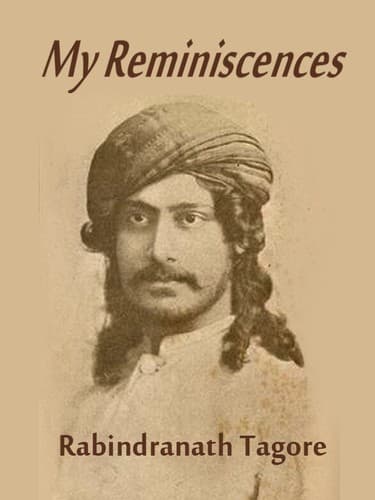
Authors, Bengali -- 20th century -- Biography; Tagore, Rabindranath, 1861-1941
How well do I remember the day our tutor tried to impress on us the
attractiveness of the English language. With this object he recited to
us with great unction some lines--prose or poetry we could not tell--out
of an English book. It had a most unlooked for effect on us. We laughed
so immoderately that he had to dismiss us for that evening. He must
have realised that he held no easy brief--that to get us to pronounce in
his favour would entail a contest ranging over years.
Aghore Babu would sometimes try to bring the zephyr of outside knowledge
to play on the arid routine of our schoolroom. One day he brought a
paper parcel out of his pocket and said: "I'll show you to-day a
wonderful piece of work of the Creator." With this he untied the paper
wrapping and, producing a portion of the vocal organs of a human being,
proceeded to expound the marvels of its mechanism.
I can still call to mind the shock this gave me at the time. I had
always thought the whole man spoke--had never even imagined that the act
of speech could be viewed in this detached way. However wonderful the
mechanism of a part may be, it is certainly less so than the whole man.
Not that I put it to myself in so many words, but that was the cause of
my dismay. It was perhaps because the tutor had lost sight of this truth
that the pupil could not respond to the enthusiasm with which he was
discoursing on the subject.
Another day he took us to the dissecting room of the Medical College.
The body of an old woman was stretched on the table. This did not
disturb me so much. But an amputated leg which was lying on the floor
upset me altogether. To view man in this fragmentary way seemed to me so
horrid, so absurd that I could not get rid of the impression of that
dark, unmeaning leg for many a day.
After getting through Peary Sarkar's first and second English readers we
entered upon McCulloch's Course of Reading. Our bodies were weary at the
end of the day, our minds yearning for the inner apartments, the book
was black and thick with difficult words, and the subject-matter could
hardly have been more inviting, for in those days, Mother
Saraswati's[14] maternal tenderness was not in evidence. Children's
books were not full of pictures then as they are now. Moreover, at the
gateway of every reading lesson stood sentinel an array of words, with
separated syllables, and forbidding accent marks like fixed bayonets,
barring the way to the infant mind. I had repeatedly attacked their
serried ranks in vain.
Our tutor would try to shame us by recounting the exploits of some other
brilliant pupil of his. We felt duly ashamed, and also not well-disposed
towards that other pupil, but this did not help to dispel the darkness
which clung to that black volume.
Public-domain text, read in full here on John Shaqi.
Reviews
Reviews
No reviews yet
Be the first to share your thoughts on this work.
Join the Discussion
Join the discussion
Sign in to leave a comment or review.
Sign InorCreate an account