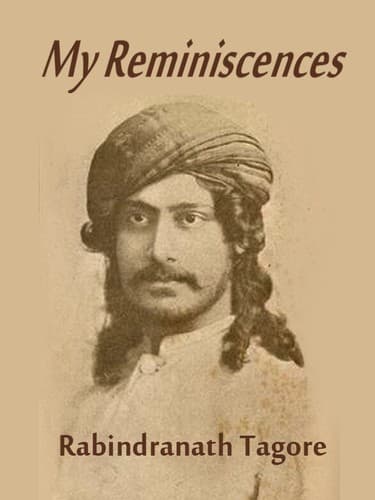
Authors, Bengali -- 20th century -- Biography; Tagore, Rabindranath, 1861-1941
At School we were then in the class below the highest one. At home we
had advanced in Bengali much further than the subjects taught in the
class. We had been through Akshay Datta's book on Popular Physics, and
had also finished the epic of Meghnadvadha. We read our physics without
any reference to physical objects and so our knowledge of the subject
was correspondingly bookish. In fact the time spent on it had been
thoroughly wasted; much more so to my mind than if it had been wasted in
doing nothing. The Meghnadvadha, also, was not a thing of joy to us. The
tastiest tit-bit may not be relished when thrown at one's head. To
employ an epic to teach language is like using a sword to shave
with--sad for the sword, bad for the chin. A poem should be taught from
the emotional standpoint; inveigling it into service as
grammar-cum-dictionary is not calculated to propitiate the divine
Saraswati.
All of a sudden our Normal School career came to an end; and thereby
hangs a tale. One of our school teachers wanted to borrow a copy of my
grandfather's life by Mitra from our library. My nephew and classmate
Satya managed to screw up courage enough to volunteer to mention this to
my father. He came to the conclusion that everyday Bengali would hardly
do to approach him with. So he concocted and delivered himself of an
archaic phrase with such meticulous precision that my father must have
felt our study of the Bengali language had gone a bit too far and was in
danger of over-reaching itself. So the next morning, when according to
our wont our table had been placed in the south verandah, the blackboard
hung up on a nail in the wall, and everything was in readiness for our
lessons with Nilkamal Babu, we three were sent for by my father to his
room upstairs. "You need not do any more Bengali lessons," he said. Our
minds danced for very joy.
Nilkamal Babu was waiting downstairs, our books were lying open on the
table, and the idea of getting us once more to go through the
Meghnadvadha doubtless still occupied his mind. But as on one's
death-bed the various routine of daily life seems unreal, so, in a
moment, did everything, from the Pandit down to the nail on which the
blackboard was hung, become for us as empty as a mirage. Our sole
trouble was how to give this news to Nilkamal Babu with due decorum. We
did it at last with considerable restraint, while the geometrical
figures on the blackboard stared at us in wonder and the blank verse of
the Meghnadvadha looked blankly on.
Our Pandit's parting words were: "At the call of duty I may have been
sometimes harsh with you--do not keep that in remembrance. You will
learn the value of what I have taught you later on."
Public-domain text, read in full here on John Shaqi.
Reviews
Reviews
No reviews yet
Be the first to share your thoughts on this work.
Join the Discussion
Join the discussion
Sign in to leave a comment or review.
Sign InorCreate an account