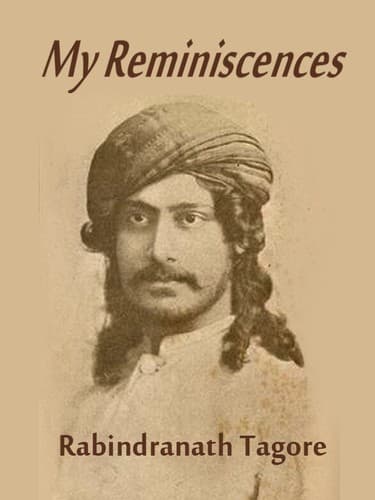
Authors, Bengali -- 20th century -- Biography; Tagore, Rabindranath, 1861-1941
In this we found an accomplice. My elder brothers had a Persian tutor.
We used to call him Munshi. He was of middle age and all skin and bone,
as though dark parchment had been stretched over his skeleton without
any filling of flesh and blood. He probably knew Persian well, his
knowledge of English was quite fair, but in neither of these directions
lay his ambition. His belief was that his proficiency in singlestick
was matched only by his skill in song. He would stand in the sun in the
middle of our courtyard and go through a wonderful series of antics with
a staff--his own shadow being his antagonist. I need hardly add that his
shadow never got the better of him and when at the end he gave a great
big shout and whacked it on the head with a victorious smile, it lay
submissively prone at his feet. His singing, nasal and out of tune,
sounded like a gruesome mixture of groaning and moaning coming from some
ghost-world. Our singing master Vishnu would sometimes chaff him: "Look
here, Munshi, you'll be taking the bread out of our mouths at this
rate!" To which his only reply would be a disdainful smile.
This shows that the Munshi was amenable to soft words; and in fact,
whenever we wanted we could persuade him to write to the school
authorities to excuse us from attendance. The school authorities took no
pains to scrutinise these letters, they knew it would be all the same
whether we attended or not, so far as educational results were
concerned.
I have now a school of my own in which the boys are up to all kinds of
mischief, for boys will be mischievous--and schoolmasters unforgiving.
When any of us are beset with undue uneasiness at their conduct and are
stirred into a resolution to deal out condign punishment, the misdeeds
of my own schooldays confront me in a row and smile at me.
I now clearly see that the mistake is to judge boys by the standard of
grown-ups, to forget that a child is quick and mobile like a running
stream; and that, in the case of such, any touch of imperfection need
cause no great alarm, for the speed of the flow is itself the best
corrective. When stagnation sets in then comes the danger. So it is for
the teacher, more than the pupil, to beware of wrongdoing.
There was a separate refreshment room for Bengali boys for meeting their
caste requirements. This was where we struck up a friendship with some
of the others. They were all older than we. One of these will bear to be
dilated upon.
Public-domain text, read in full here on John Shaqi.
Reviews
Reviews
No reviews yet
Be the first to share your thoughts on this work.
Join the Discussion
Join the discussion
Sign in to leave a comment or review.
Sign InorCreate an account