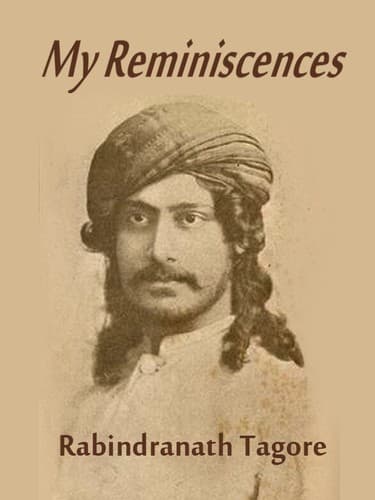
Authors, Bengali -- 20th century -- Biography; Tagore, Rabindranath, 1861-1941
Probably in order to teach me to be careful my father placed a little
small change in my charge and required me to keep an account of it. He
also entrusted me with the duty of winding his valuable gold watch for
him. He overlooked the risk of damage in his desire to train me to a
sense of responsibility. When we went out together for our morning walk
he would ask me to give alms to any beggars we came across. But I never
could render him a proper account at the end of it. One day my balance
was larger than the account warranted.
"I really must make you my cashier," observed my father. "Money seems to
have a way of growing in your hands!"
That watch of his I wound up with such indefatigable zeal that it had
very soon to be sent to the watchmaker's in Calcutta.
I am reminded of the time when, later in life, I was appointed to manage
the estate and had to lay before my father, owing to his failing
eye-sight, a statement of accounts on the second or third of every
month. I had first to read out the totals under each head, and if he had
any doubts on any point he would ask for the details. If I made any
attempt to slur over or keep out of sight any item which I feared he
would not like, it was sure to come out. So these first few days of the
month were very anxious ones for me.
As I have said, my father had the habit of keeping everything clearly
before his mind,--whether figures of accounts, or ceremonial
arrangements, or additions or alterations to property. He had never seen
the new prayer hall built at Bolpur, and yet he was familiar with every
detail of it from questioning those who came to see him after a visit to
Bolpur. He had an extraordinary memory, and when once he got hold of a
fact it never escaped him.
My father had marked his favourite verses in his copy of the
_Bhagavadgita_. He asked me to copy these out, with their translation,
for him. At home, I had been a boy of no account, but here, when these
important functions were entrusted to me, I felt the glory of the
situation.
By this time I was rid of my blue manuscript book and had got hold of a
bound volume of one of Lett's diaries. I now saw to it that my poetising
should not lack any of the dignity of outward circumstance. It was not
only a case of writing poems, but of holding myself forth as a poet
before my own imagination. So when I wrote poetry at Bolpur I loved to
do it sprawling under a young coconut palm. This seemed to me the true
poetic way. Resting thus on the hard unturfed gravel in the burning
heat of the day I composed a martial ballad on the "Defeat of King
Prithwi." In spite of the superabundance of its martial spirit, it could
not escape an early death. That bound volume of Lett's diary has now
followed the way of its elder sister, the blue manuscript book, leaving
no address behind.
We left Bolpur and making short halts on the way at Sahebganj, Dinapore,
Allahabad and Cawnpore we stopped at last at Amritsar.
Public-domain text, read in full here on John Shaqi.
Reviews
Reviews
No reviews yet
Be the first to share your thoughts on this work.
Join the Discussion
Join the discussion
Sign in to leave a comment or review.
Sign InorCreate an account