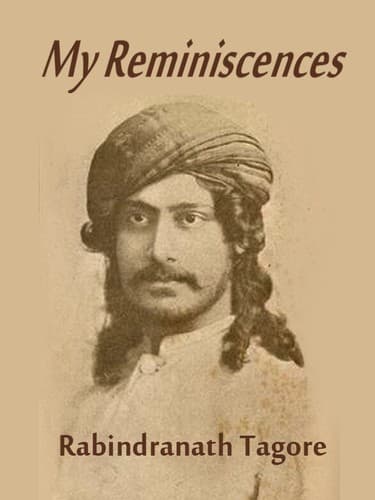
Authors, Bengali -- 20th century -- Biography; Tagore, Rabindranath, 1861-1941
But the achievement of mine which appealed most to my mother was that
while the rest of the inmates of the inner apartments had to be content
with Krittivasa's Bengali rendering of the Ramayana, I had been reading
with my father the original of Maharshi Valmiki himself, Sanscrit metre
and all. "Read me some of that Ramayana, _do_!" she said, overjoyed at
this news which I had given her.
[Illustration: The Servant-maids in the Verandah]
Alas, my reading of Valmiki had been limited to the short extract from
his Ramayana given in my Sanskrit reader, and even that I had not
fully mastered. Moreover, on looking over it now, I found that my
memory had played me false and much of what I thought I knew had become
hazy. But I lacked the courage to plead "I have forgotten" to the eager
mother awaiting the display of her son's marvellous talents; so that, in
the reading I gave, a large divergence occurred between Valmiki's
intention and my explanation. That tender-hearted sage, from his seat in
heaven, must have forgiven the temerity of the boy seeking the glory of
his mother's approbation, but not so Madhusudan,[29] the taker down of
Pride.
My mother, unable to contain her feelings at my extraordinary exploit,
wanted all to share her admiration. "You must read this to Dwijendra,"
(my eldest brother), she said.
"In for it!" thought I, as I put forth all the excuses I could think of,
but my mother would have none of them. She sent for my brother
Dwijendra, and, as soon as he arrived, greeted him, with: "Just hear
Rabi read Valmiki's Ramayan, how splendidly he does it."
It had to be done! But Madhusudan relented and let me off with just a
taste of his pride-reducing power. My brother must have been called away
while busy with some literary work of his own. He showed no anxiety to
hear me render the Sanscrit into Bengali, and as soon as I had read out
a few verses he simply remarked "Very good" and walked away.
After my promotion to the inner apartments I felt it all the more
difficult to resume my school life. I resorted to all manner of
subterfuges to escape the Bengal Academy. Then they tried putting me at
St. Xavier's. But the result was no better.
My elder brothers, after a few spasmodic efforts, gave up all hopes of
me--they even ceased to scold me. One day my eldest sister said: "We had
all hoped Rabi would grow up to be a man, but he has disappointed us the
worst." I felt that my value in the social world was distinctly
depreciating; nevertheless I could not make up my mind to be tied to the
eternal grind of the school mill which, divorced as it was from all life
and beauty, seemed such a hideously cruel combination of hospital and
gaol.
Public-domain text, read in full here on John Shaqi.
Reviews
Reviews
No reviews yet
Be the first to share your thoughts on this work.
Join the Discussion
Join the discussion
Sign in to leave a comment or review.
Sign InorCreate an account