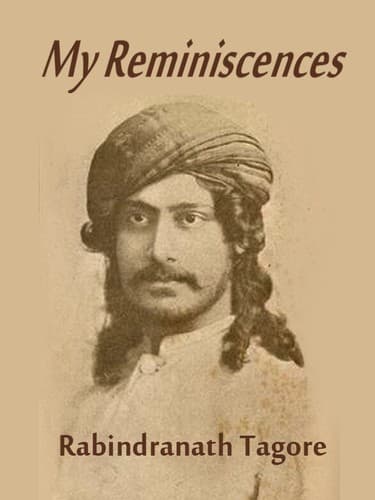
Authors, Bengali -- 20th century -- Biography; Tagore, Rabindranath, 1861-1941
The lessons I learnt from my experiences at that stage are to be found
in every moral text-book, but are not therefore to be despised. That
which keeps our appetites confined within us, and checks their free
access to the outside, poisons our life. Such is selfishness which
refuses to give free play to our desires, and prevents them from
reaching their real goal, and that is why it is always accompanied by
festering untruths and extravagances. When our desires find unlimited
freedom in good work they shake off their diseased condition and come
back to their own nature;--that is their true end, there also is the joy
of their being.
The condition of my immature mind which I have described was fostered
both by the example and precept of the time, and I am not sure that the
effects of these are not lingering on to the present day. Glancing back
at the period of which I tell, it strikes me that we had gained more of
stimulation than of nourishment out of English Literature. Our literary
gods then were Shakespeare, Milton and Byron; and the quality in their
work which stirred us most was strength of passion. In the social life
of Englishmen passionate outbursts are kept severely in check, for which
very reason, perhaps, they so dominate their literature, making its
characteristic to be the working out of extravagantly vehement feelings
to an inevitable conflagration. At least this uncontrolled excitement
was what we learnt to look on as the quintessence of English literature.
[Illustration: Moonlight]
In the impetuous declamation of English poetry by Akshay Chowdhury, our
initiator into English literature, there was the wildness of
intoxication. The frenzy of Romeo's and Juliet's love, the fury of King
Lear's impotent lamentation, the all-consuming fire of Othello's
jealousy, these were the things that roused us to enthusiastic
admiration. Our restricted social life, our narrower field of activity,
was hedged in with such monotonous uniformity that tempestuous feelings
found no entrance;--all was as calm and quiet as could be. So our hearts
naturally craved the life-bringing shock of the passionate emotion in
English literature. Ours was not the aesthetic enjoyment of literary art,
but the jubilant welcome by stagnation of a turbulent wave, even though
it should stir up to the surface the slime of the bottom.
Shakespeare's contemporary literature represents the war-dance of the
day when the Renascence came to Europe in all the violence of its
reaction against the severe curbing and cramping of the hearts of men.
The examination of good and evil, beauty and ugliness, was not the main
object,--man then seemed consumed with the anxiety to break through all
barriers to the inmost sanctuary of his being, there to discover the
ultimate image of his own violent desire. That is why in this literature
we find such poignant, such exuberant, such unbridled expression.
Public-domain text, read in full here on John Shaqi.
Reviews
Reviews
No reviews yet
Be the first to share your thoughts on this work.
Elsewhere in the archive
Join the Discussion
Join the discussion
Sign in to leave a comment or review.
Sign InorCreate an account