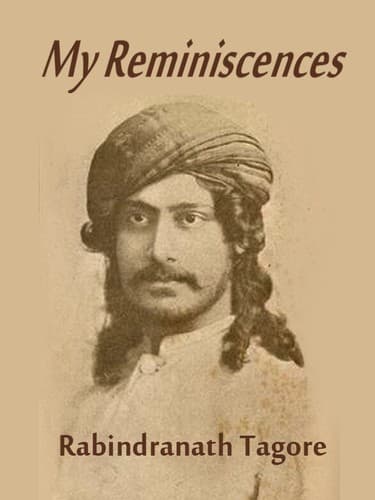
Authors, Bengali -- 20th century -- Biography; Tagore, Rabindranath, 1861-1941
The spirit of this bacchanalian revelry of Europe found entrance into
our demurely well-behaved social world, woke us up, and made us lively.
We were dazzled by the glow of unfettered life which fell upon our
custom-smothered heart, pining for an opportunity to disclose itself.
There was another such day in English literature when the slow-measure
of Pope's common time gave place to the dance-rhythm of the French
revolution. This had Byron for its poet. And the impetuosity of his
passion also moved our veiled heart-bride in the seclusion of her
corner.
In this wise did the excitement of the pursuit of English literature
come to sway the heart of the youth of our time, and at mine the waves
of this excitement kept beating from every side. The first awakening is
the time for the play of energy, not its repression.
And yet our case was so different from that of Europe. There the
excitability and impatience of bondage was a reflection from its history
into its literature. Its expression was consistent with its feeling. The
roaring of the storm was heard because a storm was really raging. The
breeze therefrom that ruffled our little world sounded in reality but
little above a murmur. Therein it failed to satisfy our minds, so that
our attempts to imitate the blast of a hurricane led us easily into
exaggeration,--a tendency which still persists and may not prove easy of
cure.
And for this, the fact that in English literature the reticence of true
art has not yet appeared, is responsible. Human emotion is only one of
the ingredients of literature and not its end,--which is the beauty of
perfect fulness consisting in simplicity and restraint. This is a
proposition which English literature does not yet fully admit.
Our minds from infancy to old age are being moulded by this English
literature alone. But other literatures of Europe, both classical and
modern, of which the art-form shows the well-nourished development due
to a systematic cultivation of self-control, are not subjects of our
study; and so, as it seems to me, we are yet unable to arrive at a
correct perception of the true aim and method of literary work.
Akshay Babu, who had made the passion in English literature living to
us, was himself a votary of the emotional life. The importance of
realising truth in the fulness of its perfection seemed less apparent to
him than that of feeling it in the heart. He had no intellectual respect
for religion, but songs of _Shy[=a]m[=a]_, the dark Mother, would bring
tears to his eyes. He felt no call to search for ultimate reality;
whatever moved his heart served him for the time as the truth, even
obvious coarseness not proving a deterrent.
Public-domain text, read in full here on John Shaqi.
Reviews
Reviews
No reviews yet
Be the first to share your thoughts on this work.
Elsewhere in the archive
Join the Discussion
Join the discussion
Sign in to leave a comment or review.
Sign InorCreate an account